Wednesday, May 15, 2013

"A little piece of paradise" (Letter #11 from Italy: April 28, 2013)


Francesca picks us up at 8:30 a.m. to go with her to the nearby village of Gorfigliano. The Custodi del Piano, a local group (of which Francesca is a member) dedicated to preserving nature in the area, is holding a fundraising event. We have no idea what to expect, but Francesca has brought along two extra pair of rubber boots for us. We stop along the way for a caffe (Francesca tells us she cannot bear to go without her morning cappuccino. We are agreeable, being fond of our coffee as well).
We arrive and are introduced to Alessandro, who owns the land we'll be exploring today, and is a founding member of the Custodi del Piano. Formed two years ago with three members, it has grown to 15 ("Slowly, slowly," says Alessandro). 
Today's adventure will include foraging for edible herbs with an expert who has come to the village from Lucca
The guide speaks Italian only, so we understand only what Francesca and others who speak English tell us. When the guide points out several herbs, he says, "mortale." We get the message. Mark, one of the other participants on the tour (he and his wife Michelle are from England and have a home in Tuscany), shares a piece of wisdom from the tour guide: "In nature, whenever you have a lethal plant, the one next to it will be the antidote. That's the balance of nature." I trust in nature's brilliance, but won't be putting this one to the test today.
Although many herbs are new to me, we see the familiar dandelion (dente de lion - lion's tooth - I will never look at the weed the same way again!). Francesca, braver and slightly more familiar than we are (although she still counts herself a beginner forager), gathers some thyme and other herbs.
For me, today is less about the herbs and more about the people and the surroundings. We are rambling the fields with locals and a few other visitors, and while we can't understand the specifics of the tour, we can soak up the experience.
The ground is wet from more than a day of rain, feeling spongy beneath our feet; the boots are a blessing. Since Judith and I can't understand the tour itself, Mark regales us with stories and facts. On the hillside, we can see a marble quarry - home of Carrerra marble. According to Mark, Michaelangelo would only carve Carrerra marble. Picasso, in addition to being a painter, was also a sculptor. He once sculpted a large horse (40x50x30) out of marble and a woman said to him, "It must be difficult to carve a horse from a block of marble." He responded, "Not really. I just cut out all the bits that don't look like a horse!"

When Mark and Michelle were househunting in Tuscany, they noted to the real estate agent that no one grows flowers. "You can't eat flowers," said the agent, and Mark notes that the Tuscans waste nothing – all plants can all be eaten. "They have a memory of hunger," says Francesca. "It is a long memory," says Mark. He says in Lucca, there are flowers everywhere (we saw this for ourselves). It is a sign of wealth.
Francesca tells us that there are many wild boar (cinghiale) in the area. While one species of local boar originated in the area, humans introduced another species, which produces more offspring, and since there are no natural predators to kill the boar, they are now overpopulated; human intervention gone awry as it does so many other places when trying to interfere with nature.
We see and hear swallows (rondine) as they swoop in the sky. "They are a sign of spring," says Francesca, who tells us the birds winter in Africa.
One of the participants stops and kneels down on the ground, staring. Several of us gather to see a butterfly (farfalla), whose wings look as if they've been intricately painted by a skilled Italian artist. On top of each wing is a small leaf-like shape that looks as if it's been woven in gold. Its wings move almost imperceptibly in and out, like breathing.
We walk past a stream, water running over raw marble and rock, and I wade into the water in my borrowed rubber boots. "You are a little bit crazy," laughs Francesca.
As we walk back toward the farm for lunch, I have a moment to talk to Alessandro. While he works outside of the village during the week to make a living, his heart is here - on the land. This place, which is his love and that of his family, fills his weekends. "You do that you like," he says. "You do that you like. Psychology," he says, pointing to his head, "...and soul," he says, placing his hand on his heart.
The group returns to the farm, hungry for lunch. There are tents, tables and benches set up outside, and there are bread and wine on the table. Before long, more food is delivered to us - a form of scrambled eggs mixed with herbs, followed by pasta with a sauce of oil and nuts, prepared outdoors by our hosts (we watched them work the pasta with their hands first thing this morning). 

Francesca gets a fresh bottle of red wine and begins to pour. She says, "Sometimes people ask me: ‘Do you drink wine?’ I say, ‘I'm from Venice!’" Not suprisingly, we have noticed many grapevines in our travels so far. Judith asks if many people use their own grapes to make wine to sell, or if they simply make it for their own consumption. Mark tells us farmers will sell their grapes (as long as they are certified as a particular variety, such as Merlot) to a co-operative, which will press them and make them into wine. "No sulfites. 100 per cent wine," he says. It is delicious. Mark recommends trying "fragolino," a light strawberry sparkling wine, while we are in Italy. I will keep an eye out for it.
 Today the clouds have been unpredictable, sometimes sprinkling, sometimes not, but generously they spare us a downpour. As we sit eating our lunch, the sun bursts out; everyone cheers.
As enjoyable as the food and wine is the conversation. Topics include the Scottish separatist movement (a conversation led by Mark and a friend from Britain) and separatist movements in general (Judith and I are able to chime in with our knowledge of Quebec), and the state of the European Union. Unemployment is remarkably high in the EU (one of the men says it's more than 50 per cent among youth in Spain). Francesca says many young people are living off the retirement savings of their parents.
Steven, a friend of Mark and Michelle’s, also from Britain, pipes up. "We're in a field drinking wine. Life is not so bad!" Francesca joins in. "Couragio. We must be courageous in everything. Let's toast - to the future - have faith!" We hold up our plastic cups of wine and touch them together. To faith - and to the future.
We finish our meal, and one of the lovely women who prepared our meal comes to see how we enjoyed it. "We did it with a lot of love," she says. "We could taste it," I tell her.
Before we leave, I stop to thank Alessandro. As is customary, he leans in to kiss me on both cheeks, and I do the same to him. "Thank you for coming," he says.
"Thank you for having us."
"It's a little piece of paradise here," he says. "Tell your friends."
"It is a little piece of paradise,” I say. “I will." 


Tuesday, May 14, 2013

A Country Gone to the Dogs (Letter #10 from Italy: April 27, 2013)


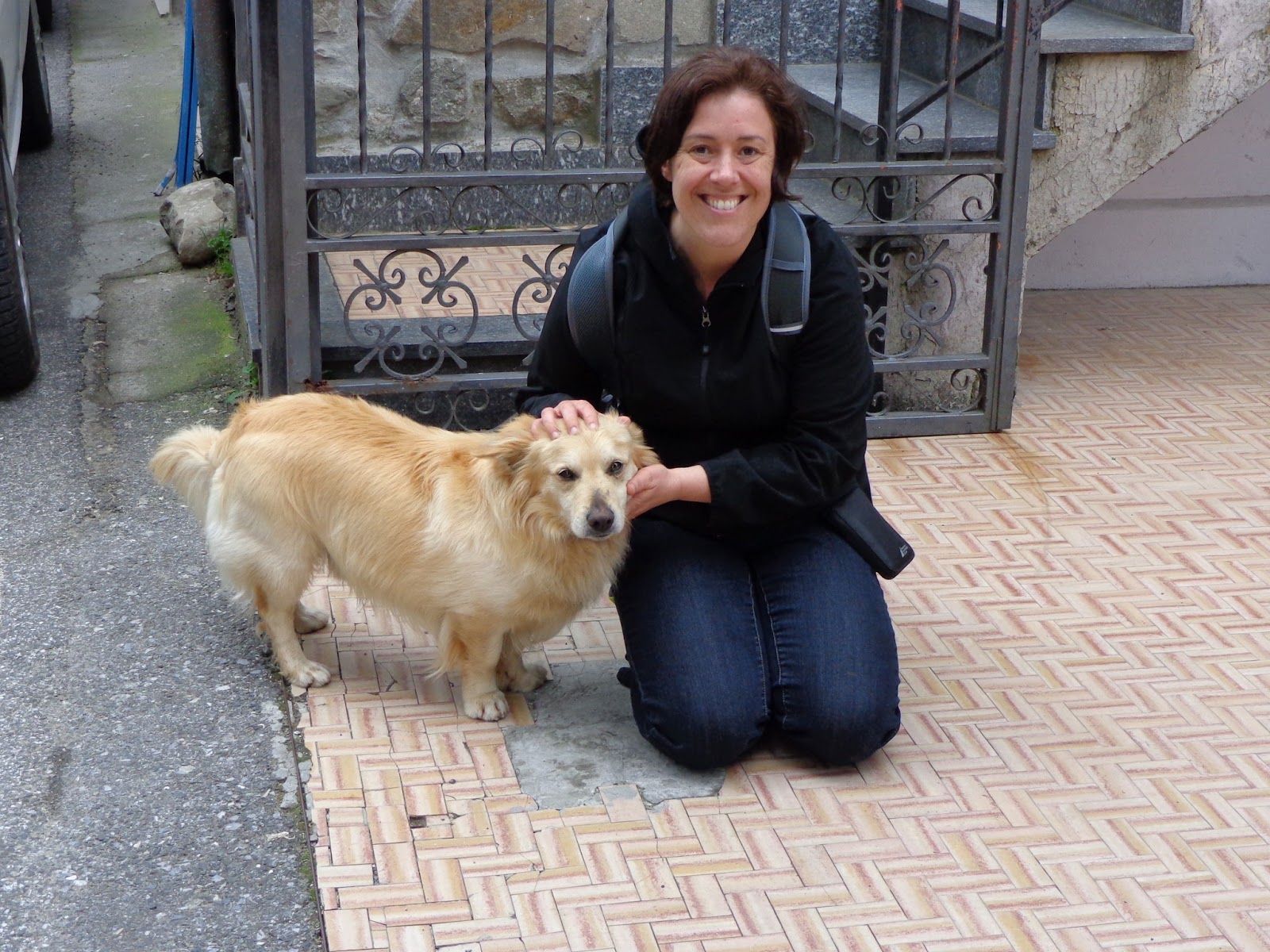
We have come to a country of dog-lovers; I am at home. Dogs here go everywhere with their owners – to markets, to restaurants and cafes, wandering the streets of the city. Almost without exception, the dogs are well behaved, friendly and gentle (I think it may simply be a factor of their contentment). 
Today we pass by a gated house with a sign: Attenti al Cane (Beware of Dog). Seeing us on the other side of the gate, a German Shepherd comes bounding toward us, tail wagging. He sits beside the sign (which pictures a ferocious dog) and looks at us with soulful eyes, oblivious to the irony.

 Cats here are a different story. They seem fiercely independent (even moreso than North American cats, although clearly I haven’t been scientific in my study. I’ve not sought out a random sample of cats in either location). Most of the cats we’ve seen have been strays, which may account for part of their indifference to humans. Like the dogs, they seem content, but their contentment seems to lie in their freedom rather than in any connection to people. Last night we passed a stray cat, walking along a brick wall above the city of La Spezia. I made the universal (I think) “psst…psst” cat call sound and reached my hand in his direction. I swear he looked over the edge of the wall, contemplated his chances of surviving the jump, and weighed it against the risk of me touching him. I decided to spare him having to choose to risk any of his lives, and moved along. When I looked back, he was continuing his independent journey. 


So I will give the Italian cats a wide berth, respecting their freedom and space. And I will continue to revel in a country devoted to its dogs, a species, much like the Italians themselves, with a gift for love.


Monday, May 13, 2013

Castelnuovo de Garfagnana and home, sweet home (Letter #9 from Italy: April 27, 2013)

It pours rain, so we don’t rush to get up and going. I am glad to have the chance to eat a leisurely breakfast (coffee, of course, and a sweetbread we bought in Riomaggiore) and catch up on my writing.
Last night, we put a load of laundry in the washer in our apartment. While the cleaning portion of the cycle appears to have gone swimmingly, the spin cycle receives a failing grade. The washer simply doesn’t spin, leaving our clothes drenched. Given the weather, putting them outside to dry isn’t an option, and placing them near the radiators (Plan C) has also failed, as our heating has stopped working (it was on the fritz when we first arrived, then was fixed, and now has thrown in the towel again). We call Francesca to let her know, and she says she’ll try to call Paola, who will call the heating man. We keep our fingers crossed. Plan D – for underwear at least – was to use the hairdryer in the apartment. That plan fell through when I found the hairdryer sitting in a small puddle made by a tiny leak in the hot water heater (of which Francesca is now aware). In the meantime, we hang our dripping clothes on a clothes rack in the kitchen with a towel underneath. Without sun or heat, they will take several days to dry (I may need to add underwear to my shopping list).

We put on the clean and dry clothes we do have, and head out with umbrellas in hand to take a train to nearby Castelnuovo de Garfagnana. There, we wander the streets and stop at the one shop that is open at 2:30 p.m. when we arrive: a shoe store called Roberta. The woman minding the store, while originally from Italy, grew up between Britain and Italy, and speaks English. We browse, and she happily encourages us in our shopping, not that I need much encouragement. I come away with a stylish pair of boots (that she chose) and a pair of leather lace-up casual shoes. “I am not allowed to buy any more shoes,” I tell Judith, even as I’m eyeing another pair (I resist, but barely).

The clerk asks why we chose this region of Italy to visit, and I answer “google” (which is essentially the truth. We searched for potential travel locations in many countries, and were both drawn to this area of Tuscany). Judith tells her we’re writers, and she asks what we’ve written (she plans to do a little googling herself). I tell her Judith has written a children’s book, and she grabs a pen to write down the title (Gracie the Public Gardens Duck). She says she’s had some “famous” people in her shoe store, including a British politician (who was unknown to us, but to this woman’s sister, was considered quite a star). We head out of the store to explore some more, our backpacks a little heavier, our wallets a little lighter.

We visit a local museum housing costumes and artifacts of the village’s past, including a list of political candidates for a regional election in 1945. There were 46 candidates – and 560 voters! The successful candidate won by a landslide with almost 400 votes.

We walk back to the train station – still in the rain – and head for home. We are hopeful that the heat will have been fixed, but no such luck. We call Francesca, who has called Paola, who has called the heating man. However, it is, after all, a holiday, Francesca reminds us. The Italians love their holidays. Thursday was the actual holiday, and it would appear the holiday really started on Wednesday and will no doubt stretch until Sunday. Given that Wednesday, May 1 is also a holiday, one wonders why a person would even bother to work in between.

We eat supper at Il Borgetto, a ristorante/pizzeria in our village (we ate pizza there the other day, and it is by far the best pizza I have ever eaten). 

Tonight I decide to try the pasta – I order tagliatelli ragu, and Judith orders scallops with mushrooms (it turns out, the scallops and mushrooms are served atop pork and Judith is a vegetarian; these are the dangers of ordering off an Italian menu, even though the waiter tried to interpret for us. However, she ate it and enjoyed it all the same). I order prosecco (the waitress confirms that I know what I’m ordering by saying, “white wine with gas”). We top it off with dessert – a moist chocolate cake for Judith and tiramisu for me, with decaf espresso (it does exist here, much to my surprise). Both are delectable.

During dinner, I am intrigued by a little boy at the table across from us. He is probably about six or seven, and full of spirit (we have notice that Italian children seem to possess a certain confidence – whether innate or taught. We admire it). His eyes gleam with mischief. I make eye contact with him a couple of times and smile. He is not sure what to think of me. He looks at his mother, looks in my direction, and asks her a question in Italian that I interpret as, “Who is that woman?” or “Why is that woman looking at me?” I laugh aloud, which only embarrasses him; he looks away. I will leave him alone from this point on. Throughout the meal, he grows restless. He climbs under the table and out the other side, then crawls across the floor of the restaurant. His parents largely ignore him and his grandfather gives a disapproving look that needs no translation. When it comes time to order dessert and the waitress lists the selections, she need go no further than “torta cioccolato.” He is sold. “Torta cioccolato! Torta cioccolato!” he chants. Chocolate torte it is!

We take our time finishing our meal, taking in the atmosphere – the locals, the British family at the table beside us enjoying pizza and red wine, the couple in the corner who were here the other night at their same table. In this place, in this moment, life is simple. Food, drink and connection in abundance. We are blessed. 

Sunday, May 12, 2013

Canadians in Cinque Terre (Letter #8 from Italy: April 26, 2013)


We board the 8:43 a.m. train from Minucciano to Riomaggiore, the first of the five islands of Cinque Terre. There is another couple on the train and we quickly realize they are from Quebec (Francesca told us last night a couple from Quebec has just arrived in the village). We introduce ourselves. Marie-Claude and Pierre are in Europe for three months and are on the Italian leg of their tour. We stop in Aulla to change trains, and are approached by a girl asking if we speak English. As it turns out, Yuko lives in Calgary (originally from Japan, immigrated to Canada 13 years ago). She too is on an extended trip – in Italy this week and then she heads to Barcelona for a two-week intensive Spanish course, followed by another two weeks travelling Spain. I am inspired; ever since I took Spanish in University, part of me has wanted to go to a Spanish speaking country and immerse myself in the language – she is doing it! (Life note: I will do this too.) We get off at different stations, and wish each other well.

On the train, we sit next to a woman who is probably in her early 40s. We don’t pay her much attention at first, until we make a stop and her face lights up. She sees a man with whom she is clearly in love. They embrace and kiss and he hands her a package. I’m not sure what their story is, but we imagine they have perhaps been separated, and are now reunited. The train is crowded so he moves to a nearby seat (I wish now I’d given him my seat, but we did get off at the next stop). She continues to glow, her eyes bright and her smile unshakeable. We are witness to her joy, and can’t help but soak a bit of it up ourselves.
When we disembark at Riomaggiore, we begin to understand what Rick Steves was telling us in his guide to Cinque Terre (he tells us to stand close to the train door and be ready to get off before the throngs of people getting on prevent us from getting out). 

We stop at the Tourist Information office and buy our walking pass. A large portion of the walk has been closed due to rock slides; the only portion remaining open is from Vernazza to Monterosso. We decide to eat breakfast in Riomaggiore, then take the boat from there to Vernazza, and then walk to Monterosso (a 1.5 hour walk, Rick tells us). 

Finding a washroom soon becomes a priority, so we follow the “WC” signs. The women’s washroom is out of order (this is the second time we have encountered this today) and both women and men are lined up for the men’s. 


The outside door to the washroom is open, so the sink is visible. It soon becomes evident that there is no running water, and I can almost see the spread of disease as one after another, each person comes out of the bathroom, pushes the sink faucet in an attempt to wash their hands, then walks away. I am tempted to leave, not wanting to be part of the disease chain, but decide I will simply skip over the touching of the sink and find another place to wash my hands (not sure where – I can’t believe I didn’t think to pack hand sanitizer!).

It is finally my turn. I open the door to the stall, only to find it truly is designed for men – it is a hole in the floor. And, to top it off, there is no toilet paper. I turn and leave immediately, vowing to find somewhere – anywhere – else to go, mentally cursing the National Park system (yes – this is a national park). Rick’s book hadn’t mentioned the state of the WCs in Cinque Terre (although he does tell us that generally, public washrooms are hard to find in Italy. He is right. One of our lessons is: If you’re in a restaurant, use their washroom, whether you have to or not). He does mention that, unfortunately, there is a history of corruption among those running the parks in Cinque Terre, happily bilking tourists. I would like one of them to be forced to use the WC.
Disgraceful washrooms aside, Cinque Terre is astoundingly beautiful. Villages built into the cliffs, terraces of gardens and olive trees overlooking the turquoise ocean. We decide to take a boat from Riomaggiore to Vernazza to see the sights from the water. We compete for photo opportunities with the many other tourists on the boat, many of them part of a few different cruises.

When we disembark in Vernazza, we hear the tour guides say to their cruise charges, “Five minutes. Get off, take pictures, get back on.” Ours will be a more leisurely exploration. We stop in a cafĂ© to use the washroom (thank you!) and then begin our hike from Vernazza to Monterosso. As we are about to start, we run into Pierre and Marie-Claude again – they have just hiked from Monterosso to here. Pierre’s face is red and sweaty. “How was it?” we ask. “Hard,” he says. They wish us luck.
Rick’s book says that this is the most challenging of the walks with many ups and downs and narrow paths. We are up for the challenge. We quickly realize it will indeed be a challenge. While we consider ourselves relatively fit, the first part of the walk is largely up, and any downhills lead quickly and predictably to more upwards treks. At points, when we encounter people hiking the opposite direction, one or other of us will flatten ourselves  to let the others pass. We see and hear hikers from many different countries, including Australia, the US, Canada and Germany (and many Italians). We pass a woman we met a couple of days ago in Lucca; she is travelling Italy with her friend, who is finishing up a military posting in Germany. As we pass fellow hikers on the path, we sometimes trade pleasantries in Italian, sometimes English, and sometimes we just smile and nod in mutual respect. One girl passes us going in the other direction. We are tackling a particularly challenging part of the trail, and are sweating and breathing heavily. “Courage,” she says. It is an apt word of encouragement, and is appreciated. We repeat this to another person a bit further down the path, and they repeat the word in Italian: “Couragio.” I imagine the word making its way around the hike, being passed from person to person.

Pierre and Marie-Claude tell us it took them two hours to complete the hike; a couple from Hamilton, Ontario tells us the same. Although we think initially we are likely more fit than most and can complete it in the 90 minutes that Rick allots, the trail demands humility, and we soon suspect it will take us the full two hours. At several points along the route, we see signs (in several languages) warning of falling rocks. While the warning is appreciated, I’m not sure it will do us much good if rocks actually begin to fall. It’s not as if there is much room to maneuver to avoid them. Judith muses aloud, “I wonder how many people they lose on these trails every year.” I would rather not reflect on that question right now, and say as much – perhaps something to google later from the safety of solid ground. At one point we see a local man working at covering a rock face with wire to prevent such rock falls – I am grateful for my office job.

There are several points that lend themselves to stunning photos. We take advantage of some opportunities, and forfeit others after weighing (very briefly) the risk of falling over the side of the mountain.

At the top of a mountain, in a small clearing, a cat lies contentedly in the sun. He obviously lives here; someone has set up food and water and a makeshift shelter in case of rain. The cat pays little attention to the passersby, stretching out to soak up the sun.

At several points in the walk, Judith says, “I think it must be all downhill from here,” (which, I reflect, takes on a whole new meaning from the usual negativity associated with downhill). “I wish you wouldn’t say that,” I say, reflecting on the times before that the downhill was quickly followed by an uphill climb. However, in the final 30 minutes or so, it is mostly downhill as we descend into Monterosso. At the 90-minute mark, we arrive in Monterosso, asking a local to take our photo together as evidence that we’ve completed the trek.

Our first post-hike stop is the train station. If we’ve learned one thing on this trip it is, “Always check the train schedule first.” They gave us a train schedule for Cinque Terre at the Tourist Information office, but it is incomprehensible; it includes all kinds of footnotes about trains running or not running certain days of the week or on holidays (and today is, after all, the day after a holiday). It is 3:15 p.m. and we find out our train leaves at 4:43. We have time to eat a late lunch. We stop at a little restaurant with a patio overlooking the beach, where brave children swim and their parents dip their toes in the water.
After lunch, we head down to the beach where I put my feet into the water. It is not warm (perhaps low teens or 15 degrees) but coming from Nova Scotia, it’s absolutely fine – and refreshing).

We head back to the station, my flip flops frothing from soaking up the salt water (a phenomenon I have never before experienced). We take the train back to Riomaggiore, where we spend another 30 minutes passing the time until our next train arrives. We wander the streets and come across a tiny café and bakery. I buy what turns out to be a perfect pastry cradling a smooth, sweet, creamy lemon filling. It is bliss.
We board the crowded train (standing room only) to see Yoku, our friend from Calgary. We greet one another like long-lost friends and marvel at the fact that we have managed to connect again. We trade details of the day and get off together at La Spezia, where Yoku is staying and we must wait for our next train. We trade contact information and promise to connect by Facebook. We encourage Yoku to come to Nova Scotia (she’s been once and loved it) and I suspect we will see her again. I tell her I want to hear all about her experiences in Barcelona, as she has inspired me and I want to do the same. We hug goodbye, certain our paths will cross again.

Judith and I have a couple of hours to wait until our train arrives, so spend our time wandering La Spezia. Like many of the Italian cities we have visited so far, a significant portion of the city is made up of stone streets with pedestrian access only, lined with shops and restaurants. We continue to muse on the fact that Dartmouth and Halifax could have this too; I have a vision of downtown Dartmouth with the same setup, drawing people from the municipality and the province (who’s on the dark side now, Haligonians?)

We take the train to Aulla, then back to Minucciano. I read my book, “The Glassblower of Murano,” set in Venice. While we won’t make it to Venice on this trip, I am already able to identify with many of the elements of Italian culture noted in the book. The train pulls into the station in Minucciano, and we stumble home, exhausted in the best possible way. 

Saturday, May 11, 2013

Loving Lucca (Letter #7 from Italy: April 24, 2013)


While spending today in Lucca was unexpected, it’s welcome.
Having enjoyed our bike ride the other day, we rent bikes again, this time for a few hours. There are several ramps from the ramparts to the stone streets, leading to shops of all kinds. We stop at a ceramic store, peruse the handmade offerings and buy a few gifts for friends and family. We continue on, stopping at shops throughout the city. We stop at a shoe store where I spot the most magnificent shoes I have ever seen. I ask to try them on in a size 38 (equivalent to our size 8). They don’t have my size in the beige (my initial request) but do have it in the most beautiful, soft shade of green. I try them on and immediately fall in love with the feel of the soft leather and the look of the shoes on my feet. I must take these home – and do.
Lucca turns out to be a shopper’s paradise, and we end up filling our bicycle baskets with our purchases – bread and cheese boards handcrafted with the wood of olive trees, an Italian leather wallet for me (to replace my wallet at home that has literally burst at the seams), and each of us buys a leather bag (mine is green leather and matches my shoes. I love the impracticality of the colour. I now need only find a dress that will complement them).
We stop and visit the Palazza Pfanner, a mansion surrounded by an exquisite garden lined by lemon trees and statues of deities of Greek Olympus and the Four Seasons. The Palazzo, built in 1660, was originally owned by the Moriconi family, members of the merchant nobility. When they went bankrupt in 1680, the building was sold to the Controni family. Felix Pfanner set up a brewery there in 1846, which remained open until 1929. The Pfanner family still owns the property, opening it to the public in 1995 (thank you for sharing your beautiful home!) 


The home houses a museum of medical-surgical instruments from the late 19th century; Pietro Pfanner was a distinguished doctor, philanthropist and mayor of Lucca from 1920 to 1922. The exhibit notes that the good doctor cared for the richest and poorest of the city, often leaving money under the pillows of the residents living in poverty so that they could afford the medication they needed. A truly good heart.

We cycle on until we reach a restaurant in the middle of an open square. We eat our lunch outside, watching life unfold around us. A young father and his toddler son chase a pigeon around the square, laughing as they run. People of all shapes and sizes sit on a nearby park bench, happily licking gelato from a nearby gelateria. A little girl (18 months to two years old), dressed in a white top and pale green jumper dress and with a generous head of dark Italian hair, uses all of her resources to carefully pull herself up onto a bench, where she sits with a man who is presumably her grandfather. Not happy to sit for long, she spends the rest of her time toddling in the square, taking it all in. Cyclists move through the square, many with children in baskets.

After our late lunch, we cycle leisurely back to the bike rental place, and walk to the train station, just a few hundred metres away. Arrivederche, Lucca. It's been a wonderful day! 

Friday, May 10, 2013

The best things in life are unplanned... (Letter #6 from Italy: April 25, 2013)


Our plan is to take the 5:50 p.m. train from Pisa to Lucca (about 30 minutes’ ride), grab a bite to eat and take the 7:40 p.m. train back to Minucciano. Partway to Lucca, we experience a delay of some kind (we’re not sure what the cause is since the explanation is in Italian, but the train has stopped, people look annoyed and the man across from me is on is cell presumably explaining the delay to his wife, who does not sound happy. He ends the call and rolls his eyes).
We eventually continue moving, and arrive at the Lucca station after 7. Given the time, we grab pizza to go and bring it back to the station. We wait for our train, and don’t think too much about it when it doesn’t arrive right at 7:40 given the fact that several trains seem to have been delayed. However, when it hasn’t arrived by 8, I go to the ticket window and ask the man if he knows when the train to Minucciano is coming. 
“No train to Minucciano,” he says.

“Yes. There was a 7:40 train on the schedule,” I say.

He looks at his watch. “It’s 8 o’clock.”

“Yes, I know,” I say, “But we’ve been here since before 7:30 and the train schedule says it was supposed to come at 7:40 p.m.
“No,” he says. “No train to Minucciano.” 
I am perplexed. “But it’s written on the schedule. Am I reading the schedule wrong?” I ask. 
“No. Times are different today. Day before a holiday.” 
The day BEFORE a holiday? “We need to get to Minucciano tonight,” I repeat. “What are our options?” He has a “not my problem” look in his eye. He sighs and types something into the computer. “You could go to Piazza al Serchi,” he says. “That’s the station before Minucciano.” (We know enough by now to know this is a far different situation than being dropped off one bus stop early). 
“Could we get a taxi to Minucciano from there?” I ask. He shrugs, which I translate to “I don’t know and/or I don’t care.” (I find out a few minutes later that I was standing between him and the end of his shift. I was not registering on his priority list). “Grazie,” I say, although I’m not sure why.
I go outside and break the news to Judith, who is as dumbfounded as I that the train schedule has changed because it’s the day BEFORE a holiday and there is no indication on the schedule of any such change. I see a conductor getting off a train, presumably at the end of his shift. “Scuzi, parla inglese?” He smiles and holds his thumb and index finger a few centimeters apart. “A little bit,” he says. “Speak slowly.” I explain our predicament and he calls one of his colleagues over. They tell us the train station at Piazza al Serchi will drop us too far to walk (a conclusion we’d already reached, but helpful to have it confirmed) and taxis will be too expensive. Our best bet will be to stay in Lucca for the night.

By this time, it’s after 8:30, so we begin looking for a hotel. We consult Rick Steves’ book and choose a bed and breakfast that looks promising. We take out Judith’s cell phone to call the number, only to find the battery is almost drained. We start walking. When we arrive at the B&B, the door is locked. We ring the bell, but no answer. We try a few more times, but no luck. There’s nothing for it but to keep walking. It’s dark and we’re not entirely sure where to go (we decide to try to find one of Rick’s other recommendations). 

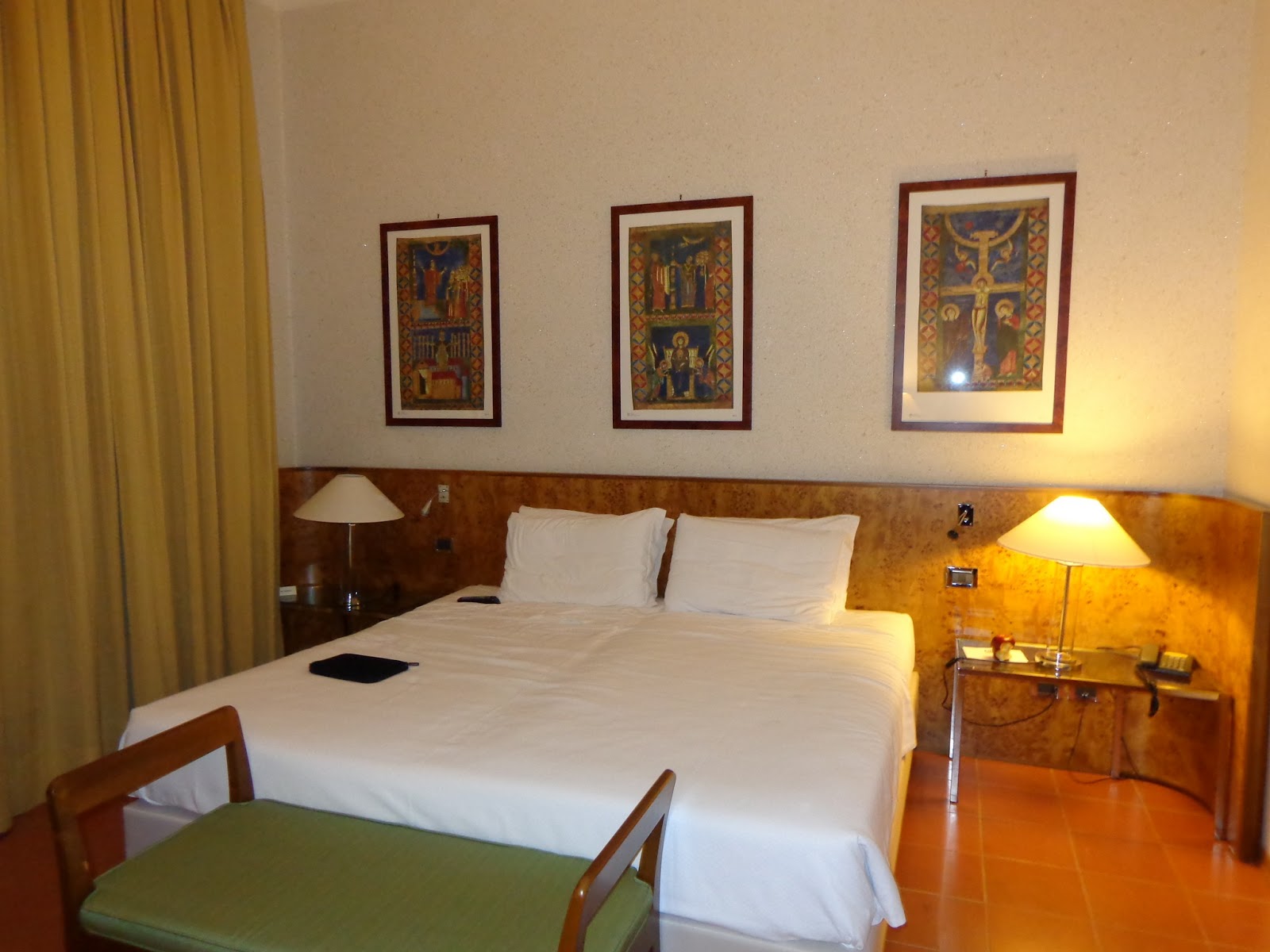
And then we see it, “Hotel Ilario.” We stop in at the front desk and are greeted with the beautiful smile of a 30-something English-speaking angel. 


We ask him if they have any double rooms. “We have one room with a double bed,” he says. “How much?” we ask. “One hundred and nine Euros, including breakfast and free wifi,” he says. “We’ll take it,” we say, figuring sharing a double bed is far better than sharing a park bench (to our delight, the bed ends up being a king size).


In the morning, we take advantage of the breakfast (on a beautiful sunny terrace), where I savour two cafĂ© lattes, eggs, bacon, fruit, bread and cheese. 

We check out after breakfast. Our friend at the front desk is still working. We thank him profusely and I ask to take his picture. “Of course,” he says. “And if you enjoyed your stay, please go to Trip Advisor and write a review.” We agree that we will. “Five dots,he says. “If you’re only going to give it four dots, don’t bother,” he jokes. “Five dots it is,” we say, and will be happy to oblige. 

Thursday, May 9, 2013

Where is that tower, again? (Letter #5 from Italy: April 24, 2013)


We’re headed to Pisa. Before we left Canada, several people advised me to keep my expectations of Pisa low. “Get off the train, look at the tower, get back on,” was their advice. We will see for ourselves. When we tell Francesca we are headed to Pisa, she encourages us to spend a couple of hours. “There was a couple who stayed here recently – they were from New Zealand – funny people,” she says.  Judith pipes up, “I’m from New Zealand.” Francesca is quick to respond. “Oh, yes. But they were from New Zealand – and funny.” She says when she told them of the things they could see in Pisa, they looked at one another and agreed, “10 minutes.” We go with an open mind.

We deliberately get off at the Pisa Centrale station (rather than Pisa S. Rossore, which is closer to the tower, because we want to stop at a tourist information office next to the station and ask a few questions about the other destinations in our roster. Unfortunately, the Pisa tourist information only gives information about Pisa). However, we’re happy to walk to the tower from here and enjoy the sights along the way. We both agree it’s a lovely city, far exceeding my low expectations. 


Rick Steves’
Florence & Tuscany has been our constant companion, but we’ve read up on Pisa and tucked it away in my bag. We ask a passerby how to get to the tower. The points and says, “Go straight.” If ever there was a time it was impossible to get lost, this was surely it. We continue straight, figuring that at some point, a tower will become obvious (as towers are wont to do).


Every block we walk, we become ever more certain that we are getting closer. Finally, we ask another passerby. He points us back in the direction we came. I am distressed by the way he is waving his arm repetitively in a way that suggests we have far overshot our destination. We pull out trusty Rick again as we turn back and retrace our steps. At every block, we ask a different person, “Tower?” We refuse to get lost again.

Within a few minutes, we find it. Its clean white contrasts against the cloudless blue sky. It is truly impressive, in the unique way that only a building that leans five degrees (15 feet) can be. 


I pity the architects and builders; it began to lean within five years of the start of building (it was built over two centuries by at least three different archtects, Rick tells us. None could fix the lean). Not exactly the sort of accomplishment you want to include on the 13th century equivalent of a resume. However, one wonders how many tourists Pisa would draw if not for the architectural oddity.

After admiring the tower (we don’t feel the need to climb it), we visit the cathedral, the bapitistery (who knew there were structures built just for baptisms?) and a museum.

We head for the Pisa S. Rossini station, just a few blocks away (admittedly, even armed with a map, we happily accept directions from a few people along the way, including a sweet teenage boy who is clearly happy to be able to use his English to direct us). Our plan is to hop on the train, stop in Lucca for supper, then catch the train home to Minucciano. The best laid plans…