Saturday, May 11, 2013

Loving Lucca (Letter #7 from Italy: April 24, 2013)


While spending today in Lucca was unexpected, it’s welcome.
Having enjoyed our bike ride the other day, we rent bikes again, this time for a few hours. There are several ramps from the ramparts to the stone streets, leading to shops of all kinds. We stop at a ceramic store, peruse the handmade offerings and buy a few gifts for friends and family. We continue on, stopping at shops throughout the city. We stop at a shoe store where I spot the most magnificent shoes I have ever seen. I ask to try them on in a size 38 (equivalent to our size 8). They don’t have my size in the beige (my initial request) but do have it in the most beautiful, soft shade of green. I try them on and immediately fall in love with the feel of the soft leather and the look of the shoes on my feet. I must take these home – and do.
Lucca turns out to be a shopper’s paradise, and we end up filling our bicycle baskets with our purchases – bread and cheese boards handcrafted with the wood of olive trees, an Italian leather wallet for me (to replace my wallet at home that has literally burst at the seams), and each of us buys a leather bag (mine is green leather and matches my shoes. I love the impracticality of the colour. I now need only find a dress that will complement them).
We stop and visit the Palazza Pfanner, a mansion surrounded by an exquisite garden lined by lemon trees and statues of deities of Greek Olympus and the Four Seasons. The Palazzo, built in 1660, was originally owned by the Moriconi family, members of the merchant nobility. When they went bankrupt in 1680, the building was sold to the Controni family. Felix Pfanner set up a brewery there in 1846, which remained open until 1929. The Pfanner family still owns the property, opening it to the public in 1995 (thank you for sharing your beautiful home!) 


The home houses a museum of medical-surgical instruments from the late 19th century; Pietro Pfanner was a distinguished doctor, philanthropist and mayor of Lucca from 1920 to 1922. The exhibit notes that the good doctor cared for the richest and poorest of the city, often leaving money under the pillows of the residents living in poverty so that they could afford the medication they needed. A truly good heart.

We cycle on until we reach a restaurant in the middle of an open square. We eat our lunch outside, watching life unfold around us. A young father and his toddler son chase a pigeon around the square, laughing as they run. People of all shapes and sizes sit on a nearby park bench, happily licking gelato from a nearby gelateria. A little girl (18 months to two years old), dressed in a white top and pale green jumper dress and with a generous head of dark Italian hair, uses all of her resources to carefully pull herself up onto a bench, where she sits with a man who is presumably her grandfather. Not happy to sit for long, she spends the rest of her time toddling in the square, taking it all in. Cyclists move through the square, many with children in baskets.

After our late lunch, we cycle leisurely back to the bike rental place, and walk to the train station, just a few hundred metres away. Arrivederche, Lucca. It's been a wonderful day! 

Friday, May 10, 2013

The best things in life are unplanned... (Letter #6 from Italy: April 25, 2013)


Our plan is to take the 5:50 p.m. train from Pisa to Lucca (about 30 minutes’ ride), grab a bite to eat and take the 7:40 p.m. train back to Minucciano. Partway to Lucca, we experience a delay of some kind (we’re not sure what the cause is since the explanation is in Italian, but the train has stopped, people look annoyed and the man across from me is on is cell presumably explaining the delay to his wife, who does not sound happy. He ends the call and rolls his eyes).
We eventually continue moving, and arrive at the Lucca station after 7. Given the time, we grab pizza to go and bring it back to the station. We wait for our train, and don’t think too much about it when it doesn’t arrive right at 7:40 given the fact that several trains seem to have been delayed. However, when it hasn’t arrived by 8, I go to the ticket window and ask the man if he knows when the train to Minucciano is coming. 
“No train to Minucciano,” he says.

“Yes. There was a 7:40 train on the schedule,” I say.

He looks at his watch. “It’s 8 o’clock.”

“Yes, I know,” I say, “But we’ve been here since before 7:30 and the train schedule says it was supposed to come at 7:40 p.m.
“No,” he says. “No train to Minucciano.” 
I am perplexed. “But it’s written on the schedule. Am I reading the schedule wrong?” I ask. 
“No. Times are different today. Day before a holiday.” 
The day BEFORE a holiday? “We need to get to Minucciano tonight,” I repeat. “What are our options?” He has a “not my problem” look in his eye. He sighs and types something into the computer. “You could go to Piazza al Serchi,” he says. “That’s the station before Minucciano.” (We know enough by now to know this is a far different situation than being dropped off one bus stop early). 
“Could we get a taxi to Minucciano from there?” I ask. He shrugs, which I translate to “I don’t know and/or I don’t care.” (I find out a few minutes later that I was standing between him and the end of his shift. I was not registering on his priority list). “Grazie,” I say, although I’m not sure why.
I go outside and break the news to Judith, who is as dumbfounded as I that the train schedule has changed because it’s the day BEFORE a holiday and there is no indication on the schedule of any such change. I see a conductor getting off a train, presumably at the end of his shift. “Scuzi, parla inglese?” He smiles and holds his thumb and index finger a few centimeters apart. “A little bit,” he says. “Speak slowly.” I explain our predicament and he calls one of his colleagues over. They tell us the train station at Piazza al Serchi will drop us too far to walk (a conclusion we’d already reached, but helpful to have it confirmed) and taxis will be too expensive. Our best bet will be to stay in Lucca for the night.

By this time, it’s after 8:30, so we begin looking for a hotel. We consult Rick Steves’ book and choose a bed and breakfast that looks promising. We take out Judith’s cell phone to call the number, only to find the battery is almost drained. We start walking. When we arrive at the B&B, the door is locked. We ring the bell, but no answer. We try a few more times, but no luck. There’s nothing for it but to keep walking. It’s dark and we’re not entirely sure where to go (we decide to try to find one of Rick’s other recommendations). 

And then we see it, “Hotel Ilario.” We stop in at the front desk and are greeted with the beautiful smile of a 30-something English-speaking angel. 


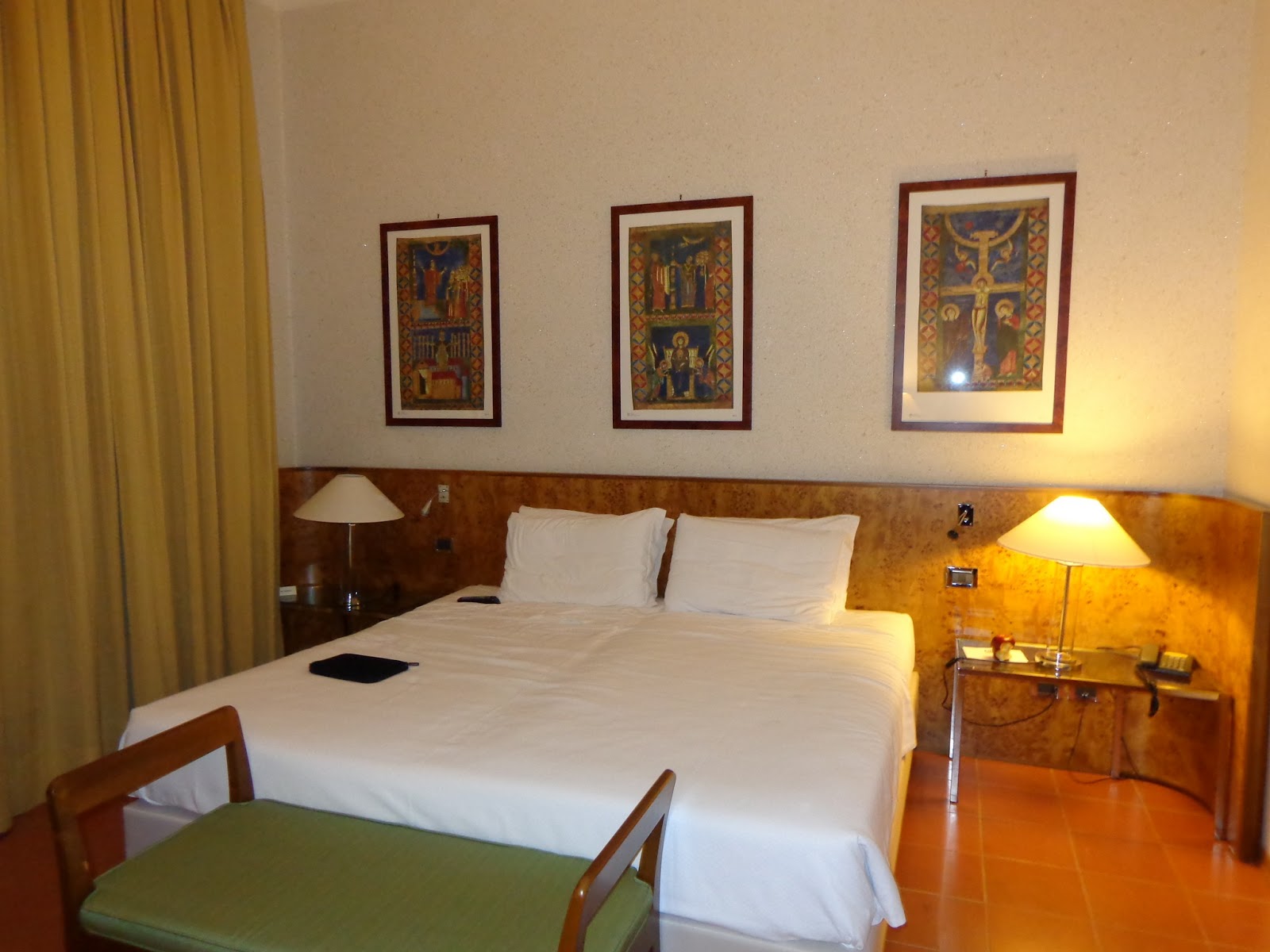
We ask him if they have any double rooms. “We have one room with a double bed,” he says. “How much?” we ask. “One hundred and nine Euros, including breakfast and free wifi,” he says. “We’ll take it,” we say, figuring sharing a double bed is far better than sharing a park bench (to our delight, the bed ends up being a king size).


In the morning, we take advantage of the breakfast (on a beautiful sunny terrace), where I savour two café lattes, eggs, bacon, fruit, bread and cheese. 

We check out after breakfast. Our friend at the front desk is still working. We thank him profusely and I ask to take his picture. “Of course,” he says. “And if you enjoyed your stay, please go to Trip Advisor and write a review.” We agree that we will. “Five dots,he says. “If you’re only going to give it four dots, don’t bother,” he jokes. “Five dots it is,” we say, and will be happy to oblige. 

Thursday, May 9, 2013

Where is that tower, again? (Letter #5 from Italy: April 24, 2013)


We’re headed to Pisa. Before we left Canada, several people advised me to keep my expectations of Pisa low. “Get off the train, look at the tower, get back on,” was their advice. We will see for ourselves. When we tell Francesca we are headed to Pisa, she encourages us to spend a couple of hours. “There was a couple who stayed here recently – they were from New Zealand – funny people,” she says.  Judith pipes up, “I’m from New Zealand.” Francesca is quick to respond. “Oh, yes. But they were from New Zealand – and funny.” She says when she told them of the things they could see in Pisa, they looked at one another and agreed, “10 minutes.” We go with an open mind.

We deliberately get off at the Pisa Centrale station (rather than Pisa S. Rossore, which is closer to the tower, because we want to stop at a tourist information office next to the station and ask a few questions about the other destinations in our roster. Unfortunately, the Pisa tourist information only gives information about Pisa). However, we’re happy to walk to the tower from here and enjoy the sights along the way. We both agree it’s a lovely city, far exceeding my low expectations. 


Rick Steves’
Florence & Tuscany has been our constant companion, but we’ve read up on Pisa and tucked it away in my bag. We ask a passerby how to get to the tower. The points and says, “Go straight.” If ever there was a time it was impossible to get lost, this was surely it. We continue straight, figuring that at some point, a tower will become obvious (as towers are wont to do).


Every block we walk, we become ever more certain that we are getting closer. Finally, we ask another passerby. He points us back in the direction we came. I am distressed by the way he is waving his arm repetitively in a way that suggests we have far overshot our destination. We pull out trusty Rick again as we turn back and retrace our steps. At every block, we ask a different person, “Tower?” We refuse to get lost again.

Within a few minutes, we find it. Its clean white contrasts against the cloudless blue sky. It is truly impressive, in the unique way that only a building that leans five degrees (15 feet) can be. 


I pity the architects and builders; it began to lean within five years of the start of building (it was built over two centuries by at least three different archtects, Rick tells us. None could fix the lean). Not exactly the sort of accomplishment you want to include on the 13th century equivalent of a resume. However, one wonders how many tourists Pisa would draw if not for the architectural oddity.

After admiring the tower (we don’t feel the need to climb it), we visit the cathedral, the bapitistery (who knew there were structures built just for baptisms?) and a museum.

We head for the Pisa S. Rossini station, just a few blocks away (admittedly, even armed with a map, we happily accept directions from a few people along the way, including a sweet teenage boy who is clearly happy to be able to use his English to direct us). Our plan is to hop on the train, stop in Lucca for supper, then catch the train home to Minucciano. The best laid plans…

Wednesday, May 8, 2013

The view from Lucca (Letter #4 from Italy: April 23, 2013)


Our initial plan for today is to head to Pisa. When we get on the train in Pieve San Lorenzo, we confirm with the conductor that we need to get off in Lucca and change trains. When the train pulls up to Bagni de Lucca, we get off and nod at the conductor. He nods and waves as we get off. Within a few minutes, we discover that Bagni de Lucca is not the same as Lucca, and we have gotten off too early. No problem. We will walk.
We follow the signs to Lucca (again, no distances noted). Not for the first time, we suffer under the “it can’t be that far” delusion. However, we have adopted the motto “no wrong way” and enjoy the exquisite sights along the way, the most notable of which is the Ponte della Maddalena, a beautiful stone bridge dating back to the 14th century. 

We cross the bridge and enter a town we think might be Lucca (it is not). It is the tiny village of Borga de Mozzano

We stop and ask a couple of Italian men who are engaged in conversation how far it is to Lucca. Their initially wordless expression tells us it is farther than we anticipated.
“Auto?” one of them says, turning an imaginary steering wheel with his hands.
“No,” I say, pointing to my feet optimistically. They laugh and shake their heads no. I ask for directions to the nearest train station, which, as luck would have it, is just down the street. We check the schedule (20 minutes until the next train), and grab a quick sandwich and our first gelato at a nearby café. We are soon back on the train on our way to Lucca. Pisa will have to wait until tomorrow.
Lucca is a charming city, still protected by a fortress wall, although, as Rick Steves’ book tells us, it has not been under threat since 1430. Atop the ramparts is a wide path for walkers and cyclists overlooking the city.
We rent bikes and cycle the ramparts, stopping to take photos or simply admire the sights.


At one of our photo stops (to admire a palazzo below), I notice a young man, about 16, explaining in somewhat hesitant English the history of the palazzo within view. A man videotapes his explanation while a woman stands nearby and whispers English translations when he gets stuck for a word, much like a prompter behind a theatre curtain. 

The teenager tells of how the original owners of the Palazzo went bankrupt and had to sell. He finishes and looks to his teacher, who prompts him with a “Follow me!” that completes this segment of the video. They turn to move on.
“We enjoyed that!” I call after them. The woman turns, clearly pleased. “You understood it?” I assure her we did. She explains that she is here with her class; they are creating an interactive English tour of Lucca that they will post on the Internet. She calls out to the boy in the video, explaining in Italian that we understood and enjoyed this portion of the tour. “Thank you,” he says with a smile. We leave them to finish their tour, as we continue ours of this beautiful city (bella citta)!

Tuesday, May 7, 2013

"No camminare" (Letter #3 from Italy, April 22)


I go to the “Centro Storico” (the village general store) first thing – my new morning routine. It’s proximity (only a few steps from our door) makes it a convenient pre-breakfast stop. I pick up a couple of tomatoes, some garlic, onion, canned tomato sauce, bread and cheese (stracchini – mild, creamy and delicious). I no sooner return home than I realize I have forgotten to buy butter (burro). In less than two minutes, I am able to make a return trip with butter in hand (1 Euro, 30 cents for half a pound:  a deal, we think, until we find a full pound in the city of Aulla for not much more than that. We buy it too. A person - if I am said person - can never have too much butter).

After breakfast, I return to the store again to ask if there is an Internet Café nearby. There is not. The nearest is in Aulla, approximately 30 minutes by train. We had planned on going to Aulla anyway, so I thank the few people who have chimed in to answer my question. Betta, who works at the store, seems concerned. “Treno, treno,” she says (train, train). “Si,” I respond. “No camminere,” (no walking) she says, shaking her head and marching on the spot, swinging her arms. I wonder if she and the other villagers have heard about yesterday’s adventure.

We head to Aulla for the afternoon, where we find one Internet Café but get spotty Internet. Oh well. We wander the streets a bit, taking our lives into our hands at times (Aulla has little regard for pedestrians – sidewalks, where they exist, are narrow and close to traffic, and crosswalks are more decorative than anything else). We stop for pizza supper and then take the train home. Francesca has been by and left a note on our door: “I passed by to see if all is ok. If you need Internet, you can come to my place and see your mail, no problem.” I suspect she has chatted with the villagers I talked to this morning. Once again, I can’t help but think we Canadians are the source of much entertainment. 

Monday, May 6, 2013

The Journey to Equi Terme (Letter #2 from Italy: April 21, 2013)

We decide on our destination for today – a little village called Equi Terme, just four kilometres away from Pieve San Lorenzo, where we are staying. “It’s walking distance,” I say, and we decide that a gentle walk to the home of a thermal hot spring is the perfect way to ease into our vacation after sleeping in (a rest well earned after more than 24 hours in transit) and a leisurely (and very late) breakfast of bread, cheese and coffee on our sunny terrace.

We pack our swimsuits, cameras, water, money and a few other essentials, perhaps most importantly, a map
(Judith and I have divided responsibilities: I am keys, train schedules and minor Italian translation; she is maps and coffee-making). 


We set off into the Italian countryside. About 30 minutes into our walk, we stop at Il Re di Macchia, a ristorante, and indulge in a delicious vegetarian lasagna. The only non-locals, we interestedly observe the 20 or so Italians seated at the table behind us (We think they may have been attending the confirmation/first communion of the children in our village, which wrapped up just before we left the apartment. The bishop visits the village once every two years to perform the ceremony). They are in animated conversation, and we notice they are not distracted by smart phones as often seems to be the case at North American gatherings now. 
After lunch, we continue our journey. We soon come to a sign listing a number of destinations, including Equi Terme. The arrow points right. And so we continue. 
We keep walking, reflecting on the fact that we seem to have been walking for quite some time; surely we must have walked four kilometres or more by now. However, we followed the sign to Equi Terme (which, I should note, did not include an accompanying distance) so must be on the right track.

We come to a crossroads, neither listing Equi Terme as a destination. Based on the other destinations listed, and cross-checking against our map, we turn left (none too confidently). We walk a short distance more and it begins to rain – light, pleasant rain, but rain all the same. We decide to turn around and ask a couple of men we’d seen standing outside a small building nearby if we’re going the right way. When we reach the building, the men are no longer outside, so I knock and open the door. Inside are several tables of Italian men, playing cards. One of the men, standing facing the door, motions with his hand for us to get out (or so I think – it now appears he was gesturing to “come in” – I have been tripped up by this gesture a couple of times since we arrived in Italy).

We stand outside for a moment, perpexed, when he comes out to see what we need. 

“Equi Terme?” we ask. Judith holds out the map. The man points to Equi Terme on the map. 

“Si,” we say. “Which way?” We point first in one direction then the other, and shrug. 

He points one way and gives us a very long, involved, Italian explanation. Then he points the other direction and does the same. We're no further ahead.

“This way or this way?” we repeat, pointing in each direction. He repeats his explanations (or something equally long and incomprehensible to us). 

Then he says something that leads us to believe he is trying to tell us we can go either way  - progress!
“Shorter way?” we say, gesturing with our hands. He points in one direction and says “seven kilometres” and in the other direction and says, “10 kilometres.” While it’s a far cry from the four-kilometre walk we envisioned when we started out a couple of hours ago, we opt for the seven-kilometre route.

The rain has stopped by now, and we are back on our way. We haven’t walked much farther when we realize we have walked into a valley
and the next phase of our journey goes straight up (Judith had commented a few minutes earlier how the bulk of our walk until now had been downhill. We suspected we'd have to pay for that at some point). 

We get part way up the hill when a little red car with an elderly Italian gentleman inside (one of the card players) pulls over on the side of the road. “Equi Terme?” he asks us. 

We respond, “Si.” 

He motions for us to get in the car and says something that makes us think (accurately or not) that he’s on his way home in the direction of Equi Terme, and will drop us. We accept. Note to Mom and Dad: This is not so much hitchhiking as it is accepting a ride from a kind, old Italian man (albeit a stranger). Frankly, continuing to walk seems the less intelligent choice at this point. We get in. 

Kind Italian Man talks non-stop at first; we understand almost nothing (I heard him say “dove,” which means “where,” but beyond that I am clueless). Judith points to grape vines outside and says, “grappa,” which as it turns out, is not the word for grape, but is an honourable guess. I suspect we’ve only confused Kind Italian Man. “What’s Italian for olive?” Judith asks me, wanting to comment on the olive groves. I search frantically for “olive” in my phrase book, but it’s not there. Judith makes no attempt to guess at its Italian translation. Probably just as well. Kind Italian Man stops trying to talk to us after that, clearly having realized the futility in it. We ride the next few minutes in silence.

He pulls over on the side of the road in a little village, which we presume is near his home. He points straight ahead to direct us onward. “Grazie, grazie,” we say, unable to express our gratitude any more eloquently. “Prego,” he nods, and we continue on our way. It seems we have come several kilometres from the point at which we were given the seven-kilometre directions, so it can’t be far now. Our legs will be ready for the hot springs when we arrive.

We keep walking. And walking. And walking. Finally, we see a sign for Equi Terme (Note to Italians: We love your country. Adding distances to your signs would make it virtually perfect). We continue. We see a couple more signs as we go, again with no indication how much farther we have to travel. My bladder has been full for at least the past hour, so am anxious to find a bathroom (while I could find a discrete spot off the road, it’s not my preference). I see a sign ahead, “Ristorante.” Phew. They’ll have a washroom. Judith sits on a nearby stone wall while I seek out the restaurant. Only there isn’t one. Just a sign, and a building that looks like it might have been a restaurant once. We continue on.

Finally, we reach a large Equi Terme sign – right in the middle of a crossroads. There is no arrow. Equi Terme could be right; it could be left. After a few moments of indecision, we choose left. We are soon rewarded. “Benvenido a Equi Terme,” the sign reads, and I cheer. 


Our excitement is short-lived. We soon discover that most things, including the hot springs, are closed (partly because it's not high season yet, and partly because it's Sunday).

There is nothing for it but to seek out the train station and head home. 

We stop a local gentleman: “Scuzi. Stazione treno?” 

He turns to his teenage son and asks him to direct us. “Straight,” he says, pointing up a small hill, “then left.” 

I decide to show off my very limited Italian. “Left. Sinestra,” I say with a smile. “Sinistra,” he corrects me with kindness. “Sinistra. Sinistra,” I say, grateful for his correction and his directions, “Grazie.”

We follow his instructions and find the train station with ease. After a short wait, we board the train, relieved. Off speeds the train through tunnels built right through the mountains, depositing us safely home to Pieve San Lorenzo in a mere seven minutes.

As it turns out, Equi Termi is just four kilometres away from Minucciano. By train. And 14.1 kilometres by foot (Google maps tells me) – a four-hour walk, give or take, with a leisurely pace, many stops and a drive from Kind Italian Man. Yet, if I had today to do over, I wouldn’t change a thing. Because today (and maybe every day) the journey matters more than the destination. 

Sunday, May 5, 2013

Letters from Italy, Intro and Letter #1: Meeting Betta

There is a time before a new adventure or journey begins where everything is a question. Who will we meet? What will we see? What stories will we gather and then sow? What will we  learn – about ourselves, about the world, or part of it? What words, phrases or images will continue to make us laugh or move us in years to come? There is something magnificent about the questions, a space where all is possible and the universe holds the answers, waiting for us to discover them. My trip to Italy (April 19 to May 5, 2013) – a voyage made with my good friend Judith - is one such adventure to me. What follows - in a series of letters - are some of the answers. Since we had little access to the Internet while we were away, I will post them now - one each day - as if they are actual letters arriving in the mail after I have arrived home.
April 21, 2013, Letter #1: Meeting Betta
It is our first morning in Pieve San Lorenzo, the small medieval Tuscan village (population approximately 600) that will be home for the next two weeks. Having undertaken a hefty voyage to get here (24+ hours) and having arrived at about 10:30 p.m.  Judith and I don’t rush to get up and ready in the morning. I am up first (I wake to roosters crowing, although no doubt I’ve slept through their early alarm), so decide to explore the village and forage some bread and cheese for our breakfast. I bring my Italian phrase book with me (this has quickly become my don’t-leave-home-without item).
“Panetteria” is “bakery” in Italian, so I wander the village looking for one. I find a “bar” (I first strike this off the list but then see, according to my Italian phrase book, that “bar” is Italian for “cafe.” A good start.) I go in and ask the woman behind the bar if there is a panetteria “vicino” (nearby). She directs me to Alberto’s, which is a ristorante (not useful for me right now, but noted for supper later). I return home empty-handed and run into Paola, the woman who owns the apartment where we’re staying.
“Panetteria?” I ask her. She speaks very little English (we made accommodation arrangements through Francesca, who manages the property and speaks good English). Paola motions with her hand, and I think she’s saying, “You stay here. I’ll be right back.” When she starts out and I don’t follow, she comes back to collect me (proving even hand signals are not universal). She points to the “Centro Storico,” the general store, and says it’ll be open soon.  She then proceeds to go get the storeowner. She introduces me to “Betta” (I think that's what I heard) and I follow her into the store. Sure enough, she has pane and formaggio. She tells me the cost – five euros. I give her the money. I am about to say farewell, but want to be sure I personalize it. I’m pretty sure Paola introduced her as “Betta,” but I don’t want to get it wrong. “Betta?” I ask, meaning to confirm her name. She then launches into a long explanation (in Italian, naturally) that I suspect is not confirmation or correction of her name. I hear her use a word that sounds as if it has the root “negotia*” in it, and I wonder if she thinks I’m trying to haggle on price. “No, no!” I exclaim, and give her a thumbs up, which does seem to be universal, or at least understood here (we’ve used it a few times already).

I return to the apartment, where we enjoy sumptuous bread, cheese and coffee (two more cups. I’m usually a decaf girl but I seems that’s sacrilege here; I'm not even sure it exists. I fully expect to return home addicted). I warn Judith that “Betta,” or whatever her name is, may now think we’re greedy Americans who don’t want to pay a fair price for bread and cheese. “I’ll just pretend I don’t know you,” says Judith, unfazed. It seems as good a solution as any.
*I later find out that “negotio” is another word for “store.” I still have no idea what Betta was saying, but feel slightly more confident I have not offended her.