Fear restricts, constrains. The fearful brain can't imagine opportunities, only threats. And the options, when faced with fear, are limited - hide in the hopes that it will disappear, or fight against its source - real or imagined. The third, more challenging option, is to summon the courage to look our fear from all sides, poke at it a little, ask it a few curious questions and see if it remains solid, or turns to dust.
Little by little, courageous act by courageous act (big or small), we begin to see fear for what it is - a shadow on the edge of our imagination, one that could overtake us, but doesn't need to.
Fear keeps us from reaching out to our neighbour, while courage takes us through the uncomfortable place of not knowing another to the well worn seat of friendship.
Fear makes us wonder what great tragedy might befall us, while courage opens our eyes to what's possible if we stretch, through hurt and uncertainty, to the other side of struggle.
Fear divides us, depleting our confidence in our own goodness and in that of others. Courage allows us to see who we are without turning away, accepting ourselves and extending that acceptance out into the world.
Fear is a natural human response, an instinct with a purpose. Left alone, experienced purely, it will dissipate as real threats subside. Fueled by imagined enemies, however, fear will overtake us, shut us down, block the light.
But even in that darkness, there is a way out, a path to hope and possibility. That path is courage.
Thursday, October 8, 2015


Wednesday, June 24, 2015
How to assemble a BBQ: A beginner’s guide
- Begin with a level of confidence that is entirely unwarranted.
- Open box, unpack pieces and ensure they are strewn about in no particular order. Place parts a sufficient distance away so that when you are delicately holding parts together and need the next piece, you have to contort yourself uncomfortably to get it.
- Place hardware, in its flimsy plastic case, on an uneven surface. This guarantees the contents will spill and you will be left scouring the floor for its tiny contents.
- Read the first step of instructions several times, trying to match the pieces in the diagram with those in front of you. Turn pieces around in your hands, looking at them from all angles. Repeat for every subsequent step.
- Express relief aloud that the bolts, washers and nuts for this BBQ only come in one size.
- After affixing the first few bolts, washers and nuts, realize you were mistaken about #5, and you simply didn’t read the diagram carefully enough to see that bolts, washers and nuts come in two sizes. Carry on.
- Try to use the “wrench” that came with the BBQ to tighten the nuts as instructed. Throw said “wrench” aside in disgust. If you feel so inclined, go and get a real wrench. If not, assure yourself it’s not that important.
- Struggle through assembly, doing with two hands what clearly requires four.
- Curse and sigh at regular intervals.
- Persevere until assembly is complete. Tell yourself your confidence in your BBQ assembly abilities was entirely well placed.
Wednesday, February 25, 2015
February: A letter written with icy fingers
I detest you, February. You've always been among my least favourite months, but I've deepened my disdain for you his year.
You may be the shortest month in days but you are the looooooongest, most offensive and meanest in spirit. I consider myself pretty laid back and easy going (at least I did until you came around this year) but you have tapped into something primal within me, something that makes me want to scream from the very core of my soul in the hopes that it will scare you into hiding. But I know you. I know that would only cause you to spit more venomous ice and snow, mixed with freezing rain for good measure. Worse yet, you would delight in it (as you have no doubt been doing).
I get that my resistance to you only makes you more powerful. I've tried to like you - or at least accept you, but I find your redeeming features so difficult to see, let alone name, that I am left feeling close to defeat. And yet, February, I'm not willing to give you that satisfaction. So here's what I've learned from you during this Godforsaken, never-ending, not-quite-over month:
- In spite of you, I can stand upright and balanced most of the time. You've tried to knock me down and sometimes you've come close, but mostly, I've held my footing.
- If I take a deep breath and resist the temptation to spin my wheels (literally) to no effect, I can sometimes free myself and my accompanying car by turning the wheel to get myself out of the rut. And the feeling that I've taken a different action and gotten a different result is pretty darn satisfying.
- You bring people together. No matter where you go in Atlantic Canada these days, people are gathering in solidarity against you. They too feel blue, fed up, beaten down - and they're speaking up. They're bonding over driveways caked in inches of ice. They're commiserating over the lack of road salt and sand, over cancelled plans and snow turned the grey-brown colour of despair. They're wishing, individually and collectively - to escape you for someplace warmer, kinder. And whether they make their escape or not, they know - we know - that we are better and stronger than you. We will survive.
- There is always July. When you seem interminable with your petulant wind and snow and icy rain tantrums, I know you will not last forever. You will soon run out of bluster and make way for the slightly more malleable March and the more optimistic April, and so on. Before we know it, you will be a distant memory we discuss (or not) over drinks on a sunny patio. And I, for one, will revel in it.
So farewell, "dear" February. Your time is drawing to a close. Do what you will in your final days. We can take it. And whatever you do, don't let the icy door hit you on the way out.
You may be the shortest month in days but you are the looooooongest, most offensive and meanest in spirit. I consider myself pretty laid back and easy going (at least I did until you came around this year) but you have tapped into something primal within me, something that makes me want to scream from the very core of my soul in the hopes that it will scare you into hiding. But I know you. I know that would only cause you to spit more venomous ice and snow, mixed with freezing rain for good measure. Worse yet, you would delight in it (as you have no doubt been doing).
I get that my resistance to you only makes you more powerful. I've tried to like you - or at least accept you, but I find your redeeming features so difficult to see, let alone name, that I am left feeling close to defeat. And yet, February, I'm not willing to give you that satisfaction. So here's what I've learned from you during this Godforsaken, never-ending, not-quite-over month:
- In spite of you, I can stand upright and balanced most of the time. You've tried to knock me down and sometimes you've come close, but mostly, I've held my footing.
- If I take a deep breath and resist the temptation to spin my wheels (literally) to no effect, I can sometimes free myself and my accompanying car by turning the wheel to get myself out of the rut. And the feeling that I've taken a different action and gotten a different result is pretty darn satisfying.
- You bring people together. No matter where you go in Atlantic Canada these days, people are gathering in solidarity against you. They too feel blue, fed up, beaten down - and they're speaking up. They're bonding over driveways caked in inches of ice. They're commiserating over the lack of road salt and sand, over cancelled plans and snow turned the grey-brown colour of despair. They're wishing, individually and collectively - to escape you for someplace warmer, kinder. And whether they make their escape or not, they know - we know - that we are better and stronger than you. We will survive.
- There is always July. When you seem interminable with your petulant wind and snow and icy rain tantrums, I know you will not last forever. You will soon run out of bluster and make way for the slightly more malleable March and the more optimistic April, and so on. Before we know it, you will be a distant memory we discuss (or not) over drinks on a sunny patio. And I, for one, will revel in it.
So farewell, "dear" February. Your time is drawing to a close. Do what you will in your final days. We can take it. And whatever you do, don't let the icy door hit you on the way out.
Wednesday, January 1, 2014
Reframing the New Year
I’ve never really gotten the big fuss over the New Year. I’ve
always found it a bit overrated, thinking it amounted to little more than an excuse for a party and a few
awkward weeks of writing the wrong date. I think part of me has resisted the
fanfare of the New Year (even the fact that it is worthy of capitalization is
notably arrogant) because I equated it with, “How have you measured up and what
do you need to change about yourself for next year?” My own thought patterns
certainly took me to this place, and I wanted nothing to do with it. Let me
just change the calendar quietly and move on.
So it is interesting that this year I find myself moved by
the change to a new year. I’m not sure why, exactly, but it feels significant
(not good or bad, just significant). I just came from the beach, where someone
before me had spelled out “2014” in rocks. Someone else had written “Happy New
Year” into the sand. It struck me that as humans, we all have a need to say, “I
am here.” And the change to a new year – and whatever rituals we associate with
it – are a chance to say, “I made it. And now I get a fresh start.”
So rather than seeing the new year as an arbitrary
self-improvement project, I’m reframing it. May I celebrate 2013 for the
moments of joy, laughter, friendship, love and adventure it offered. May I also
celebrate it for the moments of sadness and fear that pushed me to learn more
about myself and others. And as we enter into 2014, my wish for me and for you is
the same – may we experience and celebrate our place in the world, may we learn
more about ourselves, may we let go of one thing that is holding us back and take
a leap or a jump or a baby step forward, and may we connect with others who
remind us that we matter. Because we do. Here’s to exploring 2014 together.
Sunday, December 22, 2013
Your Christmas Card
Dear friends,
Your Christmas card didn’t make it into the mail.
Truthfully, it never made it out of the store. Not because I don’t love you or
value your place in my life, but because I got caught up in the December “to do”
list and this item kind of slipped off (not for the first time). So while this
note isn’t the same as a card showing up in your mailbox (perhaps by Canada post
home delivery, soon to be obsolete), it nonetheless comes from the heart.
My wishes for you this season include:
- Time with those you love, whomever that includes – friends, family, cats, dogs – the people and beings who make you feel loved and appreciated no matter the season.
- Time for yourself – A chance to take a breath, sleep in, read a book or watch a movie – whatever gives you a chance to relax and rejuvenate.
- Good food and the time to enjoy it – And maybe a good pair of “buffet pants” and a comfortable sofa for post-gluttony napping.
- Good health – May you feel strong in mind and body and able to enjoy all of the above.
And as we enter into 2014, may you dream big and plan big
enough to bring your dreams to fruition. I look forward to continuing to share the journey.
With gratitude for your place in my life,
Margaret
Sunday, September 1, 2013
Here comes the bride...
I don't remember ever not knowing Catherine. By the time we started school, we'd already known each other for what felt like years (and probably was two or three). On our first day of school, we posed with Marilou (a friend who was a year ahead of us in school), proudly wearing the smocked dresses Catherine's mother had made and holding our dishpans full of school supplies. It was the first of many milestones we'd celebrate together.
There weren't many days of my childhood that I didn't see Catherine. On summer days I'd get up bright and early, eager to call her to play. My mother insisted I wait until the respectable time of 10 a.m. The hours seemed interminable - after all, summer was wasting away. With our other friends, we would often spend much of the day in Catherine's pool (where I learned to swim) and then set our towels up on the asphalt driveway while we dried off (sun safety was not on our list of priorities back then). When we weren't swimming, we were playing hide-and-seek, cockyolly (a variation of hide-and-seek) or soccer baseball.
During the winter, we'd spend hours outside until our woolen mittens were full of miniature snowballs and our feet were numb with cold. No matter the season, our parents' standard instructions were, "Go play outside." One Christmas, when both Catherine and I were young (probably pre-school), my parents bought a small Christmas tree for the basement and let Catherine and I decorate it. We covered it with construction paper chains and tinsel. Lots of tinsel. More tinsel than should ever grace the branches of a tree. It was almost completely silver when we were finished. And we thought it was beautiful.
We spent our share of time inside too - watching "the soaps" (much to my parents' chagrin) or game shows, or playing board games. And I'd occasionally go to Catherine's for sleepovers (where I would inevitably call my parents to pick me up before midnight, thus the "occasional" nature of the sleepovers).
But Catherine was more than a conveniently located playmate. She was a true friend. When I was in grade three, my first pet, a guinea pig named Goldie, died. My mom was looking after Catherine that day, so she was with us when it happened. I remember a tear running down my cheek and Catherine, without a word, pulled out her sticker book and gave me her orange-smelly Smurfette sticker (barely scratched and sniffed). I don't think Catherine even remembers that, but I always will.
When Catherine's family took off on a year-long European adventure the year I was 12, I wondered what I would do without her for a whole year. Much to my delight, the family came home after six months. Best. Gift. Ever.
While I fell out of touch with other friends, Catherine remained in my life. We went to movies together (where I and other friends would beg her not to talk or ruin the ending), we talked endlessly about our favourite TV shows, we hung out, we told stories (Catherine's always been good at that) and we laughed - a lot.
High school came and went, university came and went and whether we went days or weeks without talking, we'd always pick up just where we left off.
Catherine has always been independent, has always lived life on her terms. She'd have been the first to tell you she'd never get married - she could never stand living with someone else for that long, wouldn't put up with anyone's crap. Then came Craig. When Catherine introduced him to us, we figured he must be somebody special. When he moved in, we wondered if he might even be the exception to her no-marriage-for-me rule. He "got" her. And she got him. And they loved each other for it. Catherine and Craig have many things in common - a love of food that could challenge the most devout foodie, a love of dogs (particularly their hounds Wallace and Harriet, who live a life that is the envy of many dogs), a love of camping (although this was an acquired taste for Catherine as far as we can tell) and a profound appreciation of naps (usually cuddled with a canine).
Today, Catherine and Craig exchange vows. Their wedding in Niagara Falls will be simple - just family and close friends (while I am not there in person I am absolutely there in heart). Catherine will proudly tell you she bought her wedding dress and shoes for less than $60 (together). I don't think she has spent a moment's stress on wedding planning, which is as it should be. Rather, she's focused on what matters - the fact that she and Craig "get" one another and love one another, today and for the rest of their lives. I couldn't wish for anything more for my lifelong friend. Catherine and Craig - I look forward to watching as you grow old together (not too quickly, you understand, as I'll be aging along with you).
There weren't many days of my childhood that I didn't see Catherine. On summer days I'd get up bright and early, eager to call her to play. My mother insisted I wait until the respectable time of 10 a.m. The hours seemed interminable - after all, summer was wasting away. With our other friends, we would often spend much of the day in Catherine's pool (where I learned to swim) and then set our towels up on the asphalt driveway while we dried off (sun safety was not on our list of priorities back then). When we weren't swimming, we were playing hide-and-seek, cockyolly (a variation of hide-and-seek) or soccer baseball.
During the winter, we'd spend hours outside until our woolen mittens were full of miniature snowballs and our feet were numb with cold. No matter the season, our parents' standard instructions were, "Go play outside." One Christmas, when both Catherine and I were young (probably pre-school), my parents bought a small Christmas tree for the basement and let Catherine and I decorate it. We covered it with construction paper chains and tinsel. Lots of tinsel. More tinsel than should ever grace the branches of a tree. It was almost completely silver when we were finished. And we thought it was beautiful.
We spent our share of time inside too - watching "the soaps" (much to my parents' chagrin) or game shows, or playing board games. And I'd occasionally go to Catherine's for sleepovers (where I would inevitably call my parents to pick me up before midnight, thus the "occasional" nature of the sleepovers).
But Catherine was more than a conveniently located playmate. She was a true friend. When I was in grade three, my first pet, a guinea pig named Goldie, died. My mom was looking after Catherine that day, so she was with us when it happened. I remember a tear running down my cheek and Catherine, without a word, pulled out her sticker book and gave me her orange-smelly Smurfette sticker (barely scratched and sniffed). I don't think Catherine even remembers that, but I always will.
When Catherine's family took off on a year-long European adventure the year I was 12, I wondered what I would do without her for a whole year. Much to my delight, the family came home after six months. Best. Gift. Ever.
While I fell out of touch with other friends, Catherine remained in my life. We went to movies together (where I and other friends would beg her not to talk or ruin the ending), we talked endlessly about our favourite TV shows, we hung out, we told stories (Catherine's always been good at that) and we laughed - a lot.
High school came and went, university came and went and whether we went days or weeks without talking, we'd always pick up just where we left off.
Catherine has always been independent, has always lived life on her terms. She'd have been the first to tell you she'd never get married - she could never stand living with someone else for that long, wouldn't put up with anyone's crap. Then came Craig. When Catherine introduced him to us, we figured he must be somebody special. When he moved in, we wondered if he might even be the exception to her no-marriage-for-me rule. He "got" her. And she got him. And they loved each other for it. Catherine and Craig have many things in common - a love of food that could challenge the most devout foodie, a love of dogs (particularly their hounds Wallace and Harriet, who live a life that is the envy of many dogs), a love of camping (although this was an acquired taste for Catherine as far as we can tell) and a profound appreciation of naps (usually cuddled with a canine).
Today, Catherine and Craig exchange vows. Their wedding in Niagara Falls will be simple - just family and close friends (while I am not there in person I am absolutely there in heart). Catherine will proudly tell you she bought her wedding dress and shoes for less than $60 (together). I don't think she has spent a moment's stress on wedding planning, which is as it should be. Rather, she's focused on what matters - the fact that she and Craig "get" one another and love one another, today and for the rest of their lives. I couldn't wish for anything more for my lifelong friend. Catherine and Craig - I look forward to watching as you grow old together (not too quickly, you understand, as I'll be aging along with you).
Wednesday, June 19, 2013
Copy that.
Tuesday, June 18,
2013
9:30 a.m. – Begin making photocopies.
9:33 a.m. – Jam photocopier.
9:33 to 9:40 a.m. – Open and close random doors and drawers
of photocopier, trying to make sense of useless diagram telling me where it’s
jammed, while muttering angrily under my breath.
9:45 a.m. – Call photocopier company and request a service
call (the sign on the copier specifically says don’t try to fix it yourself).
9:45 a.m. to 1 p.m. Do other work, eat lunch, etc.
1 p.m. – Pass by photocopier. It’s fixed! Try again to make
copies.
1:01 p.m.– Jam photocopier.
1:01 to 1:02 p.m. – Half-heartedly open and close
photocopier doors and drawers quickly, vow never to use photocopier again, then
go back to my office. I’m not calling the service guy again. Too embarrassing.
I’ll just leave it alone (apologies to the next user).
Wednesday, June 19,
2013
11:30 a.m. (after returning from morning meeting): On my
chair are several mangled papers. Someone has found me out. They have removed
my offending papers (which had my name on them) from the copier and left them
for me.
11:35 a.m. Check voicemails. “This is Rob from Ricoh
Photocopier Service calling. I can’t come by today to fix your photocopier
today, but will come tomorrow. If you need to reach me, call me at (mumble,
mumble) 460-36099 (eight digits?).” I listen to the message three times, and
still can’t decipher the number.
11:38 a.m. Try calling 460-3609 (it’s as good a guess as
any). Voicemail answers: “Hi. This is Drew.” Ooops. Wrong number. Hang up.
11:40 a.m. Cory, my co-worker, says, “Oh by the way, the
photocopier guy was looking for you this morning.”
Me: He was? This morning?
Cory: Yes.
Me: Ohhhh…he must have left that message yesterday, not
today.
Cory: Maybe. By the way, I fixed the photocopier.
Me: YOU fixed the photocopier?
Cory: Yeah. I went to use it and it was jammed so I looked
in all the doors and pulled out the jammed paper. I saw your name on it and
figured you might want it, so put it on your chair.
Me: Oops. I guess the photocopier guy came for nothing. (PS How did Cory find the papers when I couldn't?)
11:45 a.m. Phone rings. It’s 460-3609. “Ah, photocopier
guy!” I think, recognizing the number. I pick up the receiver and don’t even
bother with the usual formalities:
Me: “Hi. I’m really sorry. I requested a service call
yesterday because the photocopier was broken but now it’s fixed so you don’t
need to come anymore. I’m sorry for the confusion.”
Voice on other end of phone: “Who is this?”
Me: “It’s Margaret Angus. You’re the Ricoh photocopier
service guy, right?”
Voice: “No. You called my number.”
Me: “Oh right! Sorry! I was trying to reach the photocopier
guy and he left me a voicemail but he mumbled the number and I couldn’t make it
out but it sounded kind of like this number. But obviously it wasn’t, and you’re
not the photocopier guy and I’m really sorry. I’m going to let you get on with
your day now.”
Voice, laughing: “OK.”
11:55 a.m. (notice red light flashing on phone, indicating
another voicemail. Was it there this whole time?) “Hi. This is Rob from Ricoh
Photocopier Service. I came and fixed your photocopier. The stapling feature
wasn’t working so I cleaned that out and now it doesn’t seem to be a problem.”
11:56 a.m. I knew that
photocopier was broken.
Thursday, May 23, 2013
12 Life Lessons I Learned from Italians
All experiences teach us something; sometimes, if we're lucky, they teach us many things. My trip to Italy reminded me of some important life lessons:
- Do what you love. The world needs your passion, and will respond in kind.
- Good coffee is an art. Appreciate its subtleties and richness, and take it in slowly.
- Good food is real food; keep it simple. When preparing a meal, use ancient grains, olive oil (lots of it), spices, cheese, wine, and love. Don’t underestimate the last ingredient – it lends the strongest flavour.
- Eat in the company of people you enjoy. Take your time. Talk to one another. Share stories. Laugh.
- Be kind to animals and children. They – and you – will be better for it.
- Embrace more, and kiss on both cheeks.
- Celebrate holidays and take at least a day off on either side.
- Take a nice long break in the afternoon. Everything else will wait.
- Don’t worry if you can’t speak the same language. A smile, a nod and a thumbs up will do nicely.
- Life is meant to be enjoyed. Let go of the rush and enjoy the moment – it won’t come again.
- Appreciate art and artists.
- Give love, accept love, express love, knowing that in the end, it is all that matters.
Wednesday, May 22, 2013
Florence and Farewell (Letter # 16 from Italy: May 2 and 3, 2013)
Day 1 in Florence Florence
I’m unable
to check into the hotel for a couple of hours, so leave my backpack there and
begin wandering the city with Rick Steves’ Florence and Tuscany in hand (opened
to the map of Florence). I stop at the Santa Maria de Novella Cathedral
(literally packed with people – a shock after several days in the open Italian
countryside!) and then continue roaming.

My lack of sleep is catching up with
me, and while I intend to walk to a couple of specific destinations, I keep
finding myself falling off the map (which I blame on Florence
As Rick’s
book advised, I reserved my ticket in advance, saving myself the hours-long
lineup outside the gallery (instead waiting 20 minutes or so to get in). There
are hundreds of people in the Uffizi and it is hot (I am guessing more than 30
degrees with all of the body heat). I wander through room after room of
paintings, including those by Botticelli. Many of the paintings, not
surprisingly, depict Madonna and child, or other religious themes. While they
are stunning, I am tired and hot, and desperately need a nap. I find myself
thinking, “You should be enjoying this more,” and then cut myself some slack.
I’ve seen the highlights of the gallery, and now need to lie down.
I head back
to the hotel – the Soggiorno Anna Maria (recommended by Rick), and fall onto
the bed. I open the window to let in fresh air, which amplifies the sound
of a street musician playing what I guess to be a saxophone. He knows only one
tune (or at least plays only one over and over). His audience is clearly the
passersby and not those standing still (or lying down in my case). In spite of
that, I manage to doze for an hour, at which point I grab a shower and head
down the street to the Trattoria Katti (owned by the same people who run this
hotel).
I sit at a
table outside and enjoy the 20-degree evening. T-bone steak is listed under
their specialties, so I decide to order it. It is listed in grams rather than
the ounces that I’m used to, so I have no idea how much I’m ordering. The
minimum order is 500 grams, so I go with that. As it turns out, that is a lot
of meat (a pound, Judith tells me later). Separately, I also order roasted potatoes
and grilled vegetables, figuring I’ll have a balanced meal. I am slightly embarrassed
when the waitress delivers my pound of steak, a bowl of potatoes and a platter
of grilled vegetables.
The couple
at the table to my left is American – from Florida Calgary and have just arrived in Florence
after having been in Venice Galway ,
Irelend, where I must apparently have fish and chips (noted). About an hour
before they actually leave, Betty says they should get back to their hotel.
They then proceed to have a coffee and a limoncella and tell us more stories –
about their trips to California Florida (whose names I
didn’t get), who have an early morning tomorrow to get back to the US
The next morning
I am well rested and Florence

I stop in a little art shop and buy
a piece of mosaic art depicting the Tuscan countryside, and continue walking.
The streets are filled with vendors, many of whom are selling the same things –
leather goods, of course, and the usual souvenirs.
I have a
date at the Accademia at 11 a.m. David awaits. Seventeen feet tall with
features perfectly chiseled (literally), he is even more magnificent than I
could have imagined. His muscles and tendons are so exquisitely crafted that I
half expect to see his hand lift the rock within it, or his chest move in and
out. Michelangelo was 26 when he started David, 29 when he finished the
masterpiece made of Carrara marble (taken from
the Garfagnana region of Italy
I return to
David and circle the statue again, then stand still looking directly at his
gaze. Visitors are not allowed to take photos, and even if you were, they would
not come close to capturing his magic. On my way out, I consider buying a
postcard, but they are flat. I return to take one last look at David so my last
memory is of the real thing, not a dim reflection on paper.
I head back
to Trattoria Katti for lunch (lasagna followed by panna cotta with strawberries
and coffee) and then realize I am ready to head home to Pieve San Lorenzo. I
catch the next train.
I return
home to find Judith cooking supper – ravioli, sautéed tomatoes and other
vegetables and a Greek salad. She has invited Francesca and Paolo for supper,
even picking up ingredients from the store (thin layers of pre-made cake,
cream, Nutella and strawberries) to make a cake to celebrate Paolo’s birthday,
which is tomorrow. We enjoy a
lovely dinner with Francesca and Paolo, and sing Happy Birthday to Paolo (in
English) as we bring out the cake.

We invite Paola (who owns the apartment and is next door) to come and join us for
cake, and we all enjoy the delicious combination of coffee, hazelnut chocolate
and strawberries as we talk about everything from the Romans to travel to
American TV (ER, Dallas and General Hospital are among the shows that have been
dubbed in Italian). Francesca promises to come to Nova
Scotia to visit (and wants to see Prince Edward Island
Our guests
leave about 9, as we have an early morning; we will catch the 6 a.m. train.
Francesca says she will be there at 5:45 to take us to the train station and we
tell her no, we will walk (it is only five minutes). She agrees but says we
must call her if we need a lift.
We are up
at 5 a.m. to grab a quick breakfast (the usual bread, cheese and coffee) and
are out the door at 5:45. Francesca is outside waiting for us. “You came!” we
say, delighted, although feeling bad that she has gotten up so early on our
account. “This is no problem,” she assures us. “I wake up early.” She takes us
to the train station, where Judith buys us a round of coffee/cappuccino. Our
train pulls up at 6 a.m. and we say goodbye to Francesca, our new friend, with
the Italian embrace and kiss on both cheeks. We promise to stay in touch, and
we will.

And with
that, we are off. Grazie, Francesca. Grazie, Pieve San
Lorenzo . Grazie, Italia. I will be back.
Tuesday, May 21, 2013
An afternoon at Silvia and Carlo's (Letter #15 from Italy: May 1, 2013)
The sun is
shining, so we drink our coffee on the terrace (one of my favourite Italian
pastimes). We see Paola below. She is waving an Italian/English dictionary in
her hand and gesturing for me to come down and meet her at the door, which I
do. She points to the word “scrivere,” which means “to write,” then points to
the Italian word for “book” and then to “bambino” (children). Francesca has
told her we are writers. I say, “Si,” then look up the word for “publish” and
say “Judith, si. Me, no. Not yet.” She nods. “Nome
Today we will walk back to Francesca’s, which Francesca and our new Italian friends told us would take about 30 minutes (2.5 kilometres). We suggested it might be wise to allow extra time for us to get lost. “It is not possible to get lost,” said Francesca, and Rosita and Maria agreed. They do not know us well.
We set out from Pieve San Lorenzo at 10:45. Our instructions are simple: Cross the bridge, go right, go straight. We follow them to the letter (we tried to pay attention on the drive home last night, but it was dark. I do recall there being a turn at one point, but recollect little of the specifics and figure it will be obvious to us). The walk is uphill all the way, with many twists and turns. It’s a beautiful day – mid 20s with a slight breeze – so good for walking. After 45 minutes, however, we begin to question the Italians’ sense of distance and time, as there is no indication we are near our destination. At each curve in the road, I am hopeful. Judith is more pragmatic. By the time we’ve been walking an hour, we Francesca texts us: “You lost?” We call her and tell her where we are. “Oh, you are far away,” she says. “Stay there. I will pick you up.”


 I also get a chance to meet Italo, one of their two
donkeys (Francesca tells us that Silvia’s mother was none too pleased when they
named the donkey “Italo,” which was her father’s name). Judith asks why they
have donkeys. “I like them,” says Silvia, which is surely the best reason of
all. Also, she says, whenever anyone comes to the house, the donkeys sound
their characteristic “hee haw,” making them more reliable than any alarm
system. I ask Silvia if the
donkeys are friendly; she says they are. I later approach the fence and Italo
comes to greet me (much like a dog would, I can't help but thinking). I scratch his forehead and face and say, “That’s a good
donkey!”
I also get a chance to meet Italo, one of their two
donkeys (Francesca tells us that Silvia’s mother was none too pleased when they
named the donkey “Italo,” which was her father’s name). Judith asks why they
have donkeys. “I like them,” says Silvia, which is surely the best reason of
all. Also, she says, whenever anyone comes to the house, the donkeys sound
their characteristic “hee haw,” making them more reliable than any alarm
system. I ask Silvia if the
donkeys are friendly; she says they are. I later approach the fence and Italo
comes to greet me (much like a dog would, I can't help but thinking). I scratch his forehead and face and say, “That’s a good
donkey!”

We finish the afternoon with coffee, followed by a tour of the nearby homes that Silvia and Carlo rent out to lucky vacationers.

Today we will walk back to Francesca’s, which Francesca and our new Italian friends told us would take about 30 minutes (2.5 kilometres). We suggested it might be wise to allow extra time for us to get lost. “It is not possible to get lost,” said Francesca, and Rosita and Maria agreed. They do not know us well.
We set out from Pieve San Lorenzo at 10:45. Our instructions are simple: Cross the bridge, go right, go straight. We follow them to the letter (we tried to pay attention on the drive home last night, but it was dark. I do recall there being a turn at one point, but recollect little of the specifics and figure it will be obvious to us). The walk is uphill all the way, with many twists and turns. It’s a beautiful day – mid 20s with a slight breeze – so good for walking. After 45 minutes, however, we begin to question the Italians’ sense of distance and time, as there is no indication we are near our destination. At each curve in the road, I am hopeful. Judith is more pragmatic. By the time we’ve been walking an hour, we Francesca texts us: “You lost?” We call her and tell her where we are. “Oh, you are far away,” she says. “Stay there. I will pick you up.”
While we
wait, I talk to the goats and sheep in a nearby field.


Within a few minutes, Francesca pulls up. She is laughing. “I cannot believe
you got lost!” she says. She explains that we failed to veer left upon leaving
the village (we went straight instead, as we thought we were supposed to) and
so took an extended route up the mountain. No worries; we are back on track
now.
We stop at
Francesca and Paolo’s for a drink of water. While we’re there, Judith also
waters Francesca’s pansies, some of which are drooping sadly. Later, Judith
tells Silvia and Carlo that the plants were dying. Francesca protests: “They
were not dying. They were relaxing!”
Francesca,
Paolo, Judith and I spend the afternoon at Carlo and Silvia’s farm just a few
minutes away. They have prepared a magnificent spread on a long table in their
outdoor “living room,” which overlooks their olive grove and gardens, and has a
spectacular view of the mountains. We are treated to bread, salami, cheese,
wine, a dish similar to risotto but made with spelt (an ancient grain – 2,000
years old, which they grow here on their farm),pastry with spinach, and
foccaccia, also made with spelt.


We are
surrounded by Carlo and Silvia’s many animals (dogs, cats and hens wander the
yard); it is wonderful.


We finish the afternoon with coffee, followed by a tour of the nearby homes that Silvia and Carlo rent out to lucky vacationers.

Paolo
offers to drive us home, but we insist on walking. Francesca walks with us for
the first few minutes to ensure we’re headed in the right direction. We have a
leisurely walk home (downhill), and even with several stops to pat horses and
take pictures of scenery, we are back in Pieve San Lorenzo in 40 minutes.


Although
the clock says it’s suppertime, neither of us can imagine eating for some time
yet (those who know me will know how rarely I am in this state). I am full – in
belly and in heart.
Sunday, May 19, 2013
Dinner at Francesca and Paolo's (Letter #14 from Italy: April 30, 2013)
Francesca
has been hospitable to us beyond all expectations. Tonight she has invited us to dinner with her
and her husband, Paolo, and has even come to pick us up and take us to their place. On the
way, we stop at her brother- and sister-in-law’s farm (Carlo and Silvia - they’re
not actually related but that’s how they refer to one another) to say hello,
see their beautiful gardens and meet their many animals (four dogs, a few cats,
at least two hens and two donkeys. Francesca says if an animal needs a home,
Carlo and Sylvia will take it in. I like them already).


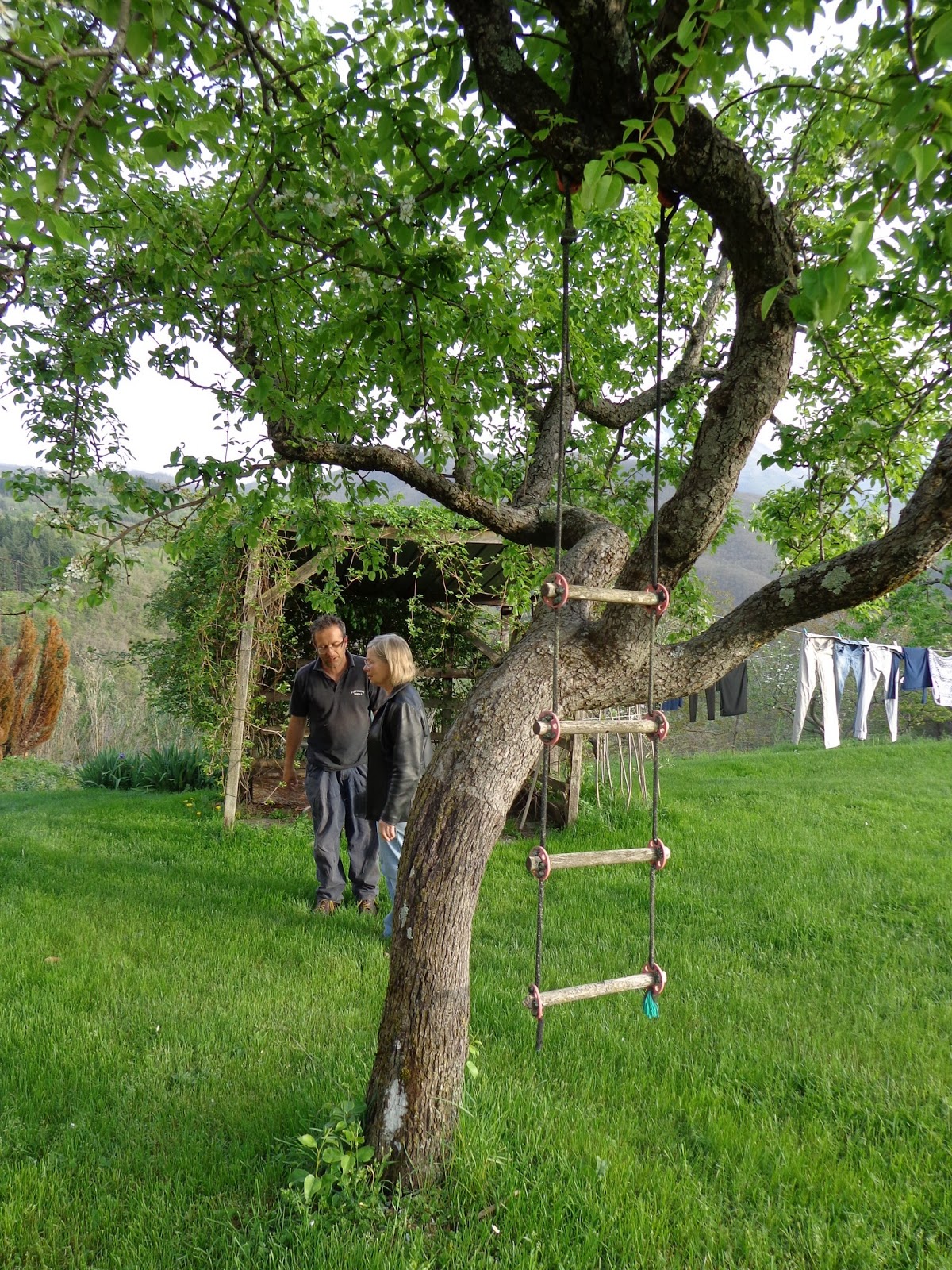
They show
us around, and Carlo apologizes for the length of the lawn (I hadn’t noticed).
“It’s a huge job mowing a lawn this big,” says Judith. “It’s a ri-di-cu-lous
job,” agrees Carlo. “I just finish the lawn and I have to start again!” They
show us around their beautiful gardens – peonies, lilacs (a pinker shade than
we have in Nova Scotia

Francesca
and Paolo’s place is just around the corner; they live within a large stone
structure that used to be the estate of a wealthy landowner. Today the building
is split into 14 units. Francesca and Paolo live in one flat and doing extensive
renovations on the flat above. Eventually, they will move into the upstairs
flat and rent the lower one (Francesca says the upstairs flat will be ready in
a month – an ambitious timeline – because they are expecting guests).
We start
out with bread, wine and several varieties of cheese, two of which are sheep’s
cheese. All are delicious. Then Francesca serves risotto with asparagus and
olive oil (also wonderful) and a blend of sautéed vegetables. Francesca mixes
water and wine – she says it is a Venetian custom that horrifies other
Italians. I try it – and like it.
Judith
happens to notice Francesca’s toaster – stainless steel with removable grills
for toasting (similar to a setup I’ve seen used for camping). Francesca says a
friend of hers gave it to her when she worked in the music business. Have we
heard of Sharday? It turns out Francesca worked for an Italian record company
for several years, and met several big stars (she tells us the story of the
time she made pasta for Mick Jagger and was too nervous to eat it herself).
Francesca
is expecting other guests shortly – a few locals who stop by for an hour once a
week to learn and practice English. Tonight we’re joined by Rosita and Maria.
Rosita brings lemon pie (torta limone); she is a magnificent baker and I tell
her so (and just in case she doesn’t understand my English or there’s any room
for misinterpretation, I eat two pieces). Throughout the evening’s
conversation, when words fail to get the point across (either in Italian or
English), we resort to gestures and sound effects (like the honking of a car
horn and the meowing of a cat).
Because
Rosita and Maria live in Pieve San Lorenzo, they generously offer to drive us
home. Although both are relative beginners in speaking English, Maria is more
confident. On the way to the car, I tell them I am trying to learn a few words
in Italian. “How do you find the grammar?” asks Maria, genuinely interested.
“Oh, I haven’t gotten to any grammar yet,” I say. “I only use nouns.”
While Maria
lives in the community before ours, Rosita tells her she’s coming with her to
drop us off. “You’re my translator!” she says to Maria, slightly panicked. We
all laugh. We say goodnight/goodbye/thank you in a mix of English and Italian,
and Judith and I head inside; it's been another full day in Italia.
Saturday, May 18, 2013
Wildlife, coffee, picnicking and Gino (Letter #13 from Italy: April 30, 2013)
It’s day two
with the car, and once again I’m in the navigator’s seat. I am becoming
slightly more comfortable with the role, although cautious of becoming too
cocky (Judith says I deserve a navigator’s badge, and I have to tell you, the
thought of it has started to go to my head).
With a few
brief wrong turns, we make it to our intended destinations largely unscathed
(it helps that neither of us is bothered if we happen to get on the “wrong”
road. We’ve seen some amazing things by taking routes we didn’t plan on taking
– today that included a baby sheep eating from her mother).

Our first
destination is Orichiella (Or-ick-ee-ella), a nature reserve. We head up, up,
up an old, winding road (all of the roads around here appear to be winding;
this one is old and not as well kept as the others we’ve driven). When we reach
the top, we get out to wander around. It would appear there’s not much
happening; we suspect we’ve arrived just before the beginning of the official
season, so the information centre is closed.We do
manage to see a few deer (in an enclosed area).


And as we wander an open area
of the park, we also come across several large, fresh piles of animal waste,
and see that the ground has been torn up in several places by an animal. From
what we know of the wildlife that inhabit this area, we think these may be the
evidence of wild boars (cinghialle, who dig up the ground in search of truffles). We are content to make it back to the car without actually seeing any face to face.
We also
spot another rare breed – a coffee shop in the mountains that is actually open.
It is almost lunchtime, but we opt instead for coffee and chocolate and pear
pie (divine). Lunch will wait.

We spend
the next couple of hours driving the rural roads of Tuscany, stopping along the
way for photo stops (although we know they will not do the mountaintop view
justice), a picnic lunch (we packed fresh bread, cheese, olives and fruit
before we left this morning) and a walk around the town of Castiglione.


Our last
stop is Castel Nuevo, where we return the car. We call Gino, the
Scottish/Italian who arranged our car rental, and he meets us at the train
station so we can follow him back to the shop. From there, he drives us back to
the station. Tomorrow (May 1) will be a rare holiday for Gino. He will spend it
with his family (his kids are 5 and 7).
We are grateful for Gino’s kindness, and tell him so as he pulls up to the
station and helps us get our bags out of the trunk. He says he always tries to
do these things for people because he’d like to think someone would do it for
him if the roles were reversed. “It’s just the way it should be,” he says. That
it should. I ask him if we can take his picture, and he agrees, although
insists he’s not photogenic and won’t look at the camera. In the picture, he is clearly uncomfortable. Part of me feels I shouldn’t have asked, and another
part feels the photo captures him perfectly as he is. Grazie, Gino.

Friday, May 17, 2013
Tuscany by car (Letter #12 from Italy: April 29, 2013)
We decide
to rent a car for a couple of days to get to some of the places we can’t access
by train (or foot, as ambitious as we are). The nearest car rental place is in Castel
Nuevo, so we take a train. Francesca has called and made the arrangements for
us; all we have to do is call the place when we arrive at the train station,
and someone will pick us up. This someone is Gino, a dark-haired man of about
40 who speaks English with a strong Scottish accent. His parents were from Italy , and he returned after many years in Scotland
We are
grateful for Gino, as neither of the other employees speak English. We fill out
the necessary paperwork and our on our way. The car is a standard (a manual, as
they say here) so Judith’s in the driver’s seat (at some point in my life, I
will learn to drive a standard). I am appointed the navigator, a role I take on
only out of necessity (maps are not my forte, you may recall, and fall under
Judith’s normal area of responsibility. The pressure is on).
We are
headed to Vente del Grotto to tour the caves there. We get there successfully,
me pointing the way and Judith skillfully handling the many
twists and turns of rural Italian roads. We do a one-hour tour of the caves. It
is my first exposure to stalagmites and stalactites in real life, my previous
experience (in books) through Mr. Burton’s grade 8 science class (until now,
the only time I’d used that knowledge was in Trivial Pursuit). Not
surprisingly, the real thing proves much more impressive; we are looking at
thousands of years of nature’s work in perfect formation. It is 10.7 degrees in
the cave today, as it is every day (every moment, in fact) of the year, no
matter what the outside temperature.

I confess
to having a few fleeting moments of wondering what would happen if we were to
be caught in here in an earthquake (a fate that is unlikely, but I imagine
unpleasant). As if reading my thoughts, our guide says that the formations in the
cave serve as a sort of cement holding the rock in place – it is anti-seismic,
she says. In 1985, there was an earthquake in the area while a tour was taking
place in the cave. The people outside were panicked. When the tour was over and
the people emerged from the cave, they wondered what all of the fuss was about.
They hadn’t felt a thing.
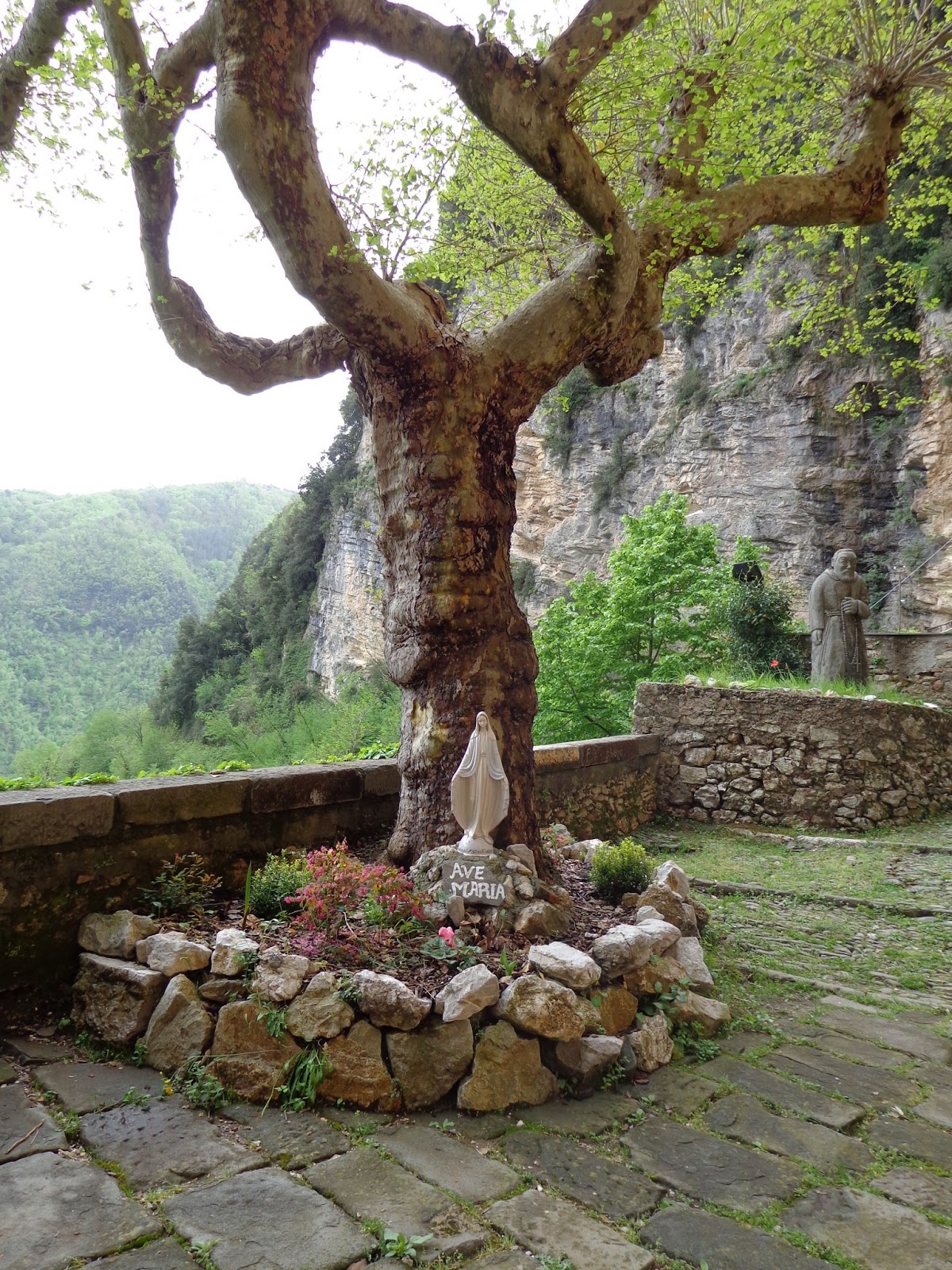
After Vente
del Grotto, we drive to the nearby Calomini Hermitage, a monastery. It is quite
and serene (no surprise there, I guess. Good choice, 7th century
monks).


From there
we seek out somewhere to eat. We are still mastering Italian mealtimes. Generally, restaurants do not open until 7
p.m. unless they are pizzerias or cafés. Having come upon several closed
restaurants, we decide to drive into nearby Barga to find somewhere to eat. We
manage to find a small pizzeria/store, so grab a couple of slices to keep us
going.
As we’re
standing on the sidewalk trying to decide where to go next, I hear someone
calling “Margaret! Margaret!” I barely
register my name since I know no one here. “Margaret! Margaret!” the call comes
again from a nearby car. I turn to see Mark, Michelle, Lizzie and Steven (our British friends from yesterday) in a
passing car. “Wait right there!” says Mark, as they park the car. Funnily, they
had not planned on coming to Barga, nor had we.
“We were
out looking at houses,” says Lizzie, handing us a brochure for a house they saw
this afternoon.
“Are you
planning to buy?” asks Judith.
“Oh no,”
says Lizzie. “It’s a rental. We picked it up for you.” She hands us the
brochure (which likely falls significantly outside of our price range, but
looks lovely, and how better to spend a summer than in Tuscany?).
We go our
separate ways and explore the city, which is, like many we’ve visited here,
built on a mountain. We have spent lots of time on this trip walking and
climbing stairs, which is likely fortuitous given our diet of bread, cheese,
pasta and gelato (one a day, which is actually quite restrained, if you consider the allure of gelato).
Finally, we
head back to the car, wanting to return home before dark. Once again, I am in
the navigator’s seat, and once again, I navigate us to our destination without
a single wrong turn (no small feat around here). Perhaps I underestimated my
abilities. All the same, I am turning the responsibility for map-reading back
to Judith as soon as we return the car.
Wednesday, May 15, 2013
"A little piece of paradise" (Letter #11 from Italy: April 28, 2013)
Francesca
picks us up at 8:30 a.m. to go with her to the nearby village of Gorfigliano
We arrive
and are introduced to Alessandro, who owns the land we'll be exploring today,
and is a founding member of the Custodi del Piano. Formed two years ago with
three members, it has grown to 15 ("Slowly, slowly," says
Alessandro).
Today's adventure will
include foraging for edible herbs with an expert who has come to the village
from Lucca

The
guide speaks Italian only, so we understand only what Francesca and others who
speak English tell us. When the guide points out several herbs, he says,
"mortale." We get the message. Mark, one of the other participants on
the tour (he and his wife Michelle are from England
and have a home in Tuscany
Although
many herbs are new to me, we see the familiar dandelion (dente de lion - lion's
tooth - I will never look at the weed the same way again!). Francesca, braver
and slightly more familiar than we are (although she still counts herself a
beginner forager), gathers some thyme and other herbs.
For me,
today is less about the herbs and more about the people and the surroundings.
We are rambling the fields with locals and a few other visitors, and while we
can't understand the specifics of the tour, we can soak up the experience.

The ground
is wet from more than a day of rain, feeling spongy beneath our feet; the boots
are a blessing. Since Judith and I can't understand the tour itself, Mark
regales us with stories and facts. On the hillside, we can see a marble quarry
- home of Carrerra marble. According to Mark, Michaelangelo would only carve
Carrerra marble. Picasso, in addition to being a painter, was also a sculptor.
He once sculpted a large horse (40x50x30) out of marble and a woman said to
him, "It must be difficult to carve a horse from a block of marble."
He responded, "Not really. I just cut out all the bits that don't look
like a horse!"


When Mark
and Michelle were househunting in Tuscany Lucca
Francesca
tells us that there are many wild boar (cinghiale) in the area. While one
species of local boar originated in the area, humans introduced another
species, which produces more offspring, and since there are no natural
predators to kill the boar, they are now overpopulated; human intervention gone
awry as it does so many other places when trying to interfere with nature.
We see and
hear swallows (rondine) as they swoop in the sky. "They are a sign of
spring," says Francesca, who tells us the birds winter in Africa .
One of the
participants stops and kneels down on the ground, staring. Several of us gather
to see a butterfly (farfalla), whose wings look as if they've been intricately
painted by a skilled Italian artist. On top of each wing is a small leaf-like
shape that looks as if it's been woven in gold. Its wings move almost
imperceptibly in and out, like breathing.
We walk
past a stream, water running over raw marble and rock, and I wade into the
water in my borrowed rubber boots. "You are a
little bit crazy," laughs Francesca.
As we walk
back toward the farm for lunch, I have a moment to talk to Alessandro. While he
works outside of the village during the week to make a living, his heart is here
- on the land. This place, which is his love and that of his family, fills his
weekends. "You do that you like," he says. "You do that you like.
Psychology," he says, pointing to his head, "...and soul," he
says, placing his hand on his heart.
The group
returns to the farm, hungry for lunch. There are tents, tables and benches set
up outside, and there are bread and wine on the table. Before long, more food
is delivered to us - a form of scrambled eggs mixed with herbs, followed by
pasta with a sauce of oil and nuts, prepared outdoors by our hosts (we watched
them work the pasta with their hands first thing this morning).


Francesca
gets a fresh bottle of red wine and begins to pour. She says, "Sometimes
people ask me: ‘Do you drink wine?’ I say, ‘I'm from Venice Italy
Today the clouds have been unpredictable,
sometimes sprinkling, sometimes not, but generously they spare us a downpour.
As we sit eating our lunch, the sun bursts out; everyone cheers.
As
enjoyable as the food and wine is the conversation. Topics include the Scottish
separatist movement (a conversation led by Mark and a friend from Britain ) and separatist movements in general
(Judith and I are able to chime in with our knowledge of Quebec Spain
Steven, a
friend of Mark and Michelle’s, also from Britain
We finish
our meal, and one of the lovely women who prepared our meal comes to see how we
enjoyed it. "We did it with a lot of love," she says. "We could
taste it," I tell her.
Before we
leave, I stop to thank Alessandro. As is customary, he leans in to kiss me on
both cheeks, and I do the same to him. "Thank you for coming," he
says.
"Thank
you for having us."
"It's
a little piece of paradise here," he says. "Tell your friends."
"It is a little piece of paradise,” I say. “I
will."


Subscribe to:
Posts (Atom)
